 |
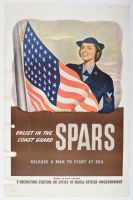
One sheet World War II recruitment poster for the SPARS, which was the women's reserve branch of the U.S. Coast Guard established on November 23, 1942.
Origin and Meaning
Name: The name is an acronym derived from the Coast Guard's Latin motto, Semper Paratus, and its English translation, Always Ready.
Purpose: The primary goal of the SPARS was to "release a man to fight at sea" by having women take over essential shore-based jobs at home.
Leadership: The program was directed by Captain Dorothy C. Stratton, who is credited with creating the "SPARS" nickname.
Service and Roles
Over 11,000 women served in the SPARS during the war. While most held administrative or clerical positions like yeomen and storekeepers, others worked in more technical or non-traditional roles:
Technical Jobs: Radio operators, air traffic controllers, and parachute riggers.
Top-Secret Work: A select group of women operated LORAN (Long Range Aid to Navigation) stations, a secret radio navigation system used by Allied ships and planes.
Location: SPARs served across the continental U.S., and eventually in the territories of Alaska and Hawaii.
Legacy
The SPARS program began demobilizing in 1945 after the war ended and was officially inactivated by 1947. This reserve paved the way for the permanent integration of women into the regular Coast Guard and Coast Guard Reserve, which was officially authorized by Congress in 1973. |
|
|