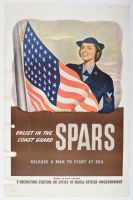
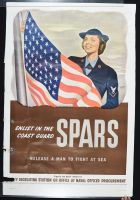
Enlist in the Coast Guard
One sheet World War II recruitment poster for the SPARS, which was the women's reserve branch of the U.S. Coast Guard established on November 23, 1942.
Origin and Meaning
Name: The name is an acronym derived from the Coast Guard's Latin motto, Semper Paratus, and its English translation, Always Ready.
Purpose: The primary goal of the SPARS was to "release a man to fight at sea" by having women take over essential shore-based jobs at home.
Leadership: The program was directed by Captain Dorothy C. Stratton, who is credited with creating the "SPARS" nickname.
Service and Roles
Over 11,000 women served in the SPARS during the war. While most held administrative or clerical positions like yeomen and storekeepers, others worked in more technical or non-traditional roles:
Technical Jobs: Radio operators, air traffic controllers, and parachute riggers.
Top-Secret Work: A select group of women operated LORAN (Long Range Aid to Navigation) stations, a secret radio navigation system used by Allied ships and planes.
Location: SPARs served across the continental U.S., and eventually in the territories of Alaska and Hawaii.
Legacy
The SPARS program began demobilizing in 1945 after the war ended and was officially inactivated by 1947. This reserve paved the way for the permanent integration of women into the regular Coast Guard and Coast Guard Reserve, which was officially authorized by Congress in 1973.
Origin and Meaning
Name: The name is an acronym derived from the Coast Guard's Latin motto, Semper Paratus, and its English translation, Always Ready.
Purpose: The primary goal of the SPARS was to "release a man to fight at sea" by having women take over essential shore-based jobs at home.
Leadership: The program was directed by Captain Dorothy C. Stratton, who is credited with creating the "SPARS" nickname.
Service and Roles
Over 11,000 women served in the SPARS during the war. While most held administrative or clerical positions like yeomen and storekeepers, others worked in more technical or non-traditional roles:
Technical Jobs: Radio operators, air traffic controllers, and parachute riggers.
Top-Secret Work: A select group of women operated LORAN (Long Range Aid to Navigation) stations, a secret radio navigation system used by Allied ships and planes.
Location: SPARs served across the continental U.S., and eventually in the territories of Alaska and Hawaii.
Legacy
The SPARS program began demobilizing in 1945 after the war ended and was officially inactivated by 1947. This reserve paved the way for the permanent integration of women into the regular Coast Guard and Coast Guard Reserve, which was officially authorized by Congress in 1973.
Mounted
Disclaimer
The object and/or subject of this report is private property. This page is for informational purposes only. Unless clearly stated otherwise, all conservation and restoration has been performed by Poster Mountain (PM) or Los Angeles Paper Group (LAPG)I) PM-LAPG has not knowingly withheld any significant information from its evaluation report and to the best of its knowledge all statements and evaluations in this report are true and correct.
II) PM-LAPG stated in the Evaluation Report its own personal, unbiased and professional analysis, opinions and conclusions, which are subject to the assumptions and limited conditions in this evaluation report as set forth hereinabove.
III) PM-LAPG has no present or prospective interests in the property which is the subject matter of this report and it has no present or prospective personal interests or bias with respect to the participants in this matter.
IV) PM-LAPG and its employment and/or compensation for performing this evaluation or any future anticipated evaluation was not conditioned on any agreement or understanding, written or otherwise, that it would report (or present analysis in support) as predetermined specific authenticity, a predetermined evaluation that favors the cause of any party or the attainment of any specific result or occurrence of a specific subsequent event, such as value or marketability.
V) PM-LAPG prepared all opinions and conclusions about the subject property that were set forth in this Evaluation Report. If it has relied on significant evaluation assistance from any individual or individuals in the performance of this evaluation or the appropriation of this evaluation report, PM-LAPG has named such individuals and disclosed the specific task performed in this evaluation report. PM-LAPG certifies that any individual so named is qualified to the same extent as PM to perform the task. PM-LAPG has not authorized anyone to make a change to any item in this evaluation report, therefore, any change made to this evaluation is unauthorized and PM-LAPG will not take responsibility for it.
VI) The Client may not disclose or distribute this Evaluation Report to any potential purchasers of the subject property without first obtaining PM-LAPG's prior written consent. This consent must be obtained before this evaluation report may be disclosed or distributed to any other party, including, but not limited to, the public through advertising, public relations, news, sales, or other media.