 |
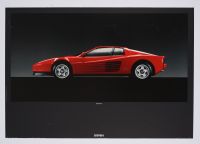
One sheet Ferrari Testarossa, the iconic original model produced from 1984 to 1991. It can be identified as the original Testarossa model, rather than the later 512 TR or F512 M variants, by specific visual cues:
Identification Details
Front Bumper: The original Testarossa features a distinct, flatter front bumper with a smaller black grille compared to the more rounded, body-colored bumper and larger grille introduced on the 512 TR.
Rear Sail Panel: The buttresses (sail panels) that flow from the roof to the rear deck feature a black perforated air grille and a slight step where they meet the roofline. The later 512 TR had a plain, smooth transition in this area, without the step or the black grille.
Wheels: The image shows the five-spoke star-pattern wheels characteristic of the Testarossa. The original model came with 16-inch wheels, which were updated to larger 18-inch wheels on the 512 TR. The wheels on the car in the image appear to be the smaller 16-inch size.
General Information
Production: The Testarossa was produced from 1984 to 1991, with roughly 7,177 units built.
Engine: It is powered by a 4.9-liter flat-12 engine (a 180° V12) that produces around 385 to 390 horsepower. The name "Testarossa" means "red head" in Italian, referring to the red-painted valve covers on the engine.
Cultural Impact: The car is widely recognized as a cultural icon of the 1980s, popularized by media like the television series Miami Vice and the video game Out Run.
Design Functionality: The car's wide body and signature side strakes were functional design elements by Pininfarina, intended to channel air to the side-mounted radiators to keep the engine cool and reduce cockpit heat, a problem with its predecessor, the 512 BBi. |
|
|