 |
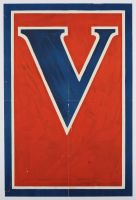
Halfsheet "V for Victory" propaganda poster used during both World War I and World War II. It features a bold blue letter "V", outlined in white, set against a vibrant red background, framed by a blue and white border. Key Information Purpose: The poster was a tool for morale and mobilization on the home front, encouraging citizens to support the war effort.Campaign: This specific design was used for the Victory Liberty Loan campaign toward the end of and immediately after World War I, and appeared again during World War II. The original WWI poster included the word "INVEST" printed below the V, encouraging people to buy U.S. government bonds.Symbolism:The "V" stands for Victory and freedom.The symbol was widely adopted by Allied nations during WWII as a sign of resistance against Nazi occupation.The Morse code for "V" is three dots and a dash (\(\bullet \bullet \bullet —\)), which coincides with the opening rhythm of Beethoven's Fifth Symphony, a common broadcast signal used during the war.Historical Context: The "V for Victory" campaign originated in 1941 with a Belgian politician and BBC broadcaster named Victor de Laveleye, and was famously popularized by British Prime Minister Winston Churchill, who used the V-sign hand gesture frequently in public appearances. |
|
|