 |
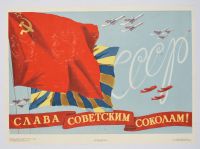
Antikbar, 19x26 vintage Soviet propaganda poster is titled "
Glory to the Soviet Falcons!" The term "Soviet Falcons" was used to refer to Soviet pilots or the Soviet Air Force.
Poster Details
Title (English): Glory to the Soviet Falcons!
Publication Year: 1955
Illustrators: V. Naryshkin and M. Eltsufen
Message: The poster is a piece of aviation propaganda, celebrating and glorifying the strength and achievements of the Soviet Air Force and its pilots.
Visual Elements
Flags: The image features a large red Soviet flag with the hammer and sickle emblem, alongside a blue and yellow flag with a stylized rising sun motif, representing military and civil aviation.
Aircraft: Various jet and propeller military aircraft are shown flying in the sky, with one formation in the background subtly forming the initials for the USSR in the clouds.
Style: The artwork is done in the style of Socialist Realism, which was the officially approved art form in the Soviet Union intended to promote the ideals of communism.
The aircraft depicted in the poster are stylized illustrations rather than exact technical representations, which was a common practice in propaganda art to idealize the subject
. However, they bear a resemblance to real Soviet Air Force planes from the 1950s era.
Identified Aircraft Types
Jet Fighters (forming "CCCP" in the background): These swept-wing aircraft likely represent the Mikoyan-Gurevich MiG-15 or MiG-17 fighters, which were the cutting-edge Soviet jet fighters of that period.
Bombers (top right formation): The larger, multi-engine jets at the very top of the poster could be stylized versions of early Soviet jet bombers, such as the Myasishchev M-4 'Bison' or the Tupolev Tu-16, which were the backbone of the Soviet long-range aviation force in the mid-1950s.
Propeller Aircraft (foreground, red): The smaller, red-nosed aircraft in the lower right are likely propeller-driven, possibly representing earlier models like the Yakovlev Yak-1 or its successors, which were prominent during World War II and the immediate post-war years. |
|
|