 |
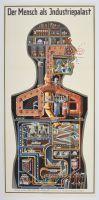
One sheet panel famous 1926 illustration by the German physician
Fritz Kahn titled Der Mensch als Industriepalast (Man as Industrial Palace). The work is a pioneering example of infographics, using a visual metaphor to explain complex human physiology to a general audience.
Key Information
Artist/Author: Fritz Kahn (1888-1968), a German-Jewish gynecologist and popular science writer.
Publication Year: 1926.
Original Context: It was published as a large, color lithographic poster and included as a supplement to the second volume of Kahn's five-volume work, Das Leben des Menschen (The Life of Man).
Concept and Meaning: The illustration depicts the human body as a complex and efficient industrial factory or chemical plant.
Organs and Functions: Organs are represented by mechanical equivalents, and little human "workers" are shown operating the machinery.
Examples: The brain is a switchboard, the lungs are bellows, the stomach is a rock-sorting mechanism, and the intestines are a system of pipes and conveyor belts.
Cultural Context: The image is considered a significant cultural product of the Weimar era in Germany, reflecting the period's fascination with industrial modernity and the "machine aesthetic".
Legacy: Kahn's work has had a lasting impact, inspiring artists and later being translated into an interactive application and a video game. |
|
|