 |
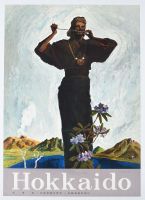
One sheet vintage travel poster, titled
"Hokkaido," features an original 1953 painting by the renowned Japanese graphic designer Kenichi Kuriyagawa (1911–1999).
The artwork depicts an Ainu girl playing a traditional mouth harp called a mukkuri. Kuriyagawa was celebrated for his posters promoting tourism in Hokkaido, the Sapporo Snow Festival, and the Winter Olympics. This specific piece was issued by the Sapporo Tourism Federation Railway Administration.
The artist behind this poster is
Kenichi Kuriyagawa (1911–1999), a self-taught graphic designer widely regarded as the "Father of Hokkaido Design".
Artistic Profile & Career
Kuriyagawa was a pioneer who helped define the visual identity of post-war Hokkaido. His career reached significant heights both domestically and internationally:
Global Recognition: In 1956, he represented Japan at the Japanese Graphic Design Exhibition at the Museum of Modern Art (MoMA) in New York, where eight of his posters were showcased.
Olympic Legacy: He designed the official posters and graphics for the 1972 Sapporo Winter Olympics—the first ever held in Asia. He also contributed to bids for the 1964 Tokyo and 1984 Sapporo Games.
Design Educator: In 1962, he founded the Hokkaido Design Center, the first educational facility of its kind in the region, to mentor future generations of designers.
Signature Style
Kuriyagawa’s work is celebrated for merging local cultural identity with global modernist aesthetics. His posters typically feature:
Dramatic Composition: He frequently used extreme perspectives, such as bird's-eye views and long shots, to convey the vastness of the Hokkaido landscape.
Minimalist Elements: His style is defined by simplified geometric forms, bold, flat colors, and expressive lines.
Cultural Themes: Many of his works, like the one you shared, focus on indigenous Ainu culture or the natural beauty of Hokkaido’s mountains, lakes, and seasons. |
|
|