 |
Fine art by Rembrandt
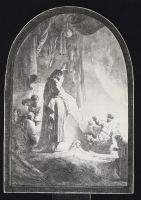
The Raising of Lazarus: The Larger Plate, an etching, engraving, and drypoint print created by the Dutch artist Rembrandt van Rijn around 1632. This piece is considered a masterpiece of the Dutch Golden Age and a powerful example of Rembrandt's skill as a printmaker.
Artwork Details
Artist: Rembrandt van Rijn (Dutch, 1606–1669)
Title: The Raising of Lazarus: The Larger Plate
Date: Circa 1632
Medium: Etching, engraving, and drypoint on paper
Location: Impressions of this print are held in major museum collections, including The Metropolitan Museum of Art and The Art Institute of Chicago.
Interpretation and Style
Biblical Narrative: The artwork depicts the climactic moment from the Gospel of John, Chapter 11, where Christ miraculously raises Lazarus from the dead. Christ, with his back to the viewer, raises a hand in command, while Lazarus begins to stir in his tomb.
Dramatic Lighting: Rembrandt masterfully uses chiaroscuro (strong contrasts of light and dark) to heighten the drama. A bright beam of light illuminates Lazarus in the dark cave, focusing the viewer's attention on the miracle and the reactions of the onlookers.
Symbolism: The scene emphasizes the themes of faith and divine grace. The composition, with Christ's hand forming the apex of a triangle extending to Lazarus, visually reinforces the power dynamics of the scene. |
|
|