 |
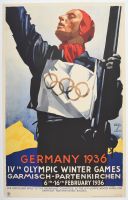
One sheet the official poster for the
IV Olympic Winter Games, which took place in Garmisch-Partenkirchen, Germany, from February 6 to February 16, 1936.
Designed by the renowned German artist Ludwig Hohlwein, the poster is a celebrated example of Art Deco-era graphic design.
Key Details of the Poster
Imagery: It depicts a victorious skier basking in glory, wearing a white bib featuring the Olympic rings. The athlete is set against the backdrop of yellow-tinged Alpine mountain peaks, specifically representing the Garmisch-Partenkirchen Alps.
Style: The poster showcases Hohlwein’s characteristic style, defined by bold interlocking shapes, sharp color contrasts, and asymmetrical lines.
Reach: Due to its popularity, the poster was printed in 13 different languages for worldwide distribution.
Historical Significance
The "Nazi Olympics": These Games were the first Olympics held under Nazi rule. They served as a "trial run" for the more famous Summer Olympics in Berlin held later that same year.
Propaganda: The Nazi regime used the Games to present a peaceful, civilized image of Germany to the international community. For the duration of the event, anti-Jewish signs were temporarily removed from public view in the Garmisch region.
Sporting Milestones: These Games featured the Olympic debut of Alpine skiing (combined downhill and slalom). Norway dominated the medal table, led by speed skater Ivar Ballangrud, who won three gold medals. |
|
|