 |
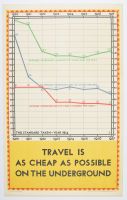
One sheet This poster is a notable example of London Underground's 1920s-era promotional graphics, specifically designed to advocate for the system's affordability during a period of economic fluctuation following World War I.Historical Context and PurposeProduced in 1927, the poster was part of a broader campaign led by Frank Pick, then-head of publicity for the Underground Group. Pick transformed the network's advertising by commissioning artists to create "pictorial posters" that served as a "poor man's picture gallery" for commuters.While many 1920s posters focused on glamorous destinations or leisure activities to encourage off-peak travel, this specific poster uses a data-driven approach to justify travel costs. It compares the "increased amount of wages" against the "cost of living" and the "rate of fare charged" to argue that the Underground remained a "cheap" and efficient option for Londoners.Key Features of the PosterData Comparison: Using 1914 as a baseline (standard year), the graph tracks three key metrics from 1920 to 1927:Wages (Green Line): Shows a significant increase compared to 1914 levels.Cost of Living (Blue Line): Illustrates the post-war inflation peak followed by a gradual decline.Fares (Red Line): Remains the lowest of the three, visually supporting the slogan: "Travel is as cheap as possible on the Underground."Design Style: It utilizes bold, simple typography and a clean, grid-based layout typical of the transition into the Art Deco movement, which peaked during this decade.Graphic Identity: The use of bright colors and a distinctive border (the "chequerboard" pattern often associated with London Transport's identity) made such posters instantly recognizable at Tube stations. |
|
|