
The Turn Of The Tune
Fine art by Currier and Ives hand-colored lithograph titled
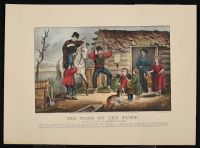
The Turn of the Tune. Traveller Playing the "Arkansaw Traveller.", published by the American printmaking firm Currier & Ives in 1870. It illustrates the second part of a well-known 19th-century American folk story and tune.
The Story Behind the Print
The print is the companion piece to another titled The Arkansas Traveler and depicts the resolution of a humorous encounter between two characters.
The First Part (The Encounter): The story, based on an 1840 experience of Colonel Sandford C. Faulkner, involves a well-dressed traveler getting lost in rural Arkansas and asking for directions and lodging at a squatter's ramshackle cabin. The squatter is unhelpful, giving curt, witty answers and continuously playing only the first half of a fiddle tune.
The Second Part (The Turn of the Tune): As shown in this image, the traveler, who is also a musician, offers to play the rest of the tune, also known as "the turn of the tune". Delighted to finally hear the complete melody he had been trying to remember for years, the squatter and his family become extremely hospitable, offering the traveler a month's lodging, the best bed, and the best corn cakes his wife can make.
Cultural Significance
The story and accompanying tune, which became the official state historic song of Arkansas in 1987, became widespread in American popular culture through minstrel shows, vaudeville acts, and prints like this one. The image and dialogue, however, also perpetuated a "hillbilly" or "backwoods" stereotype of Arkansas for many years, which some locals felt was detrimental to the state's image.
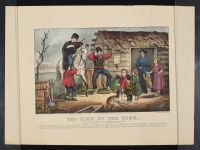
The Turn of the Tune. Traveller Playing the "Arkansaw Traveller.", published by the American printmaking firm Currier & Ives in 1870. It illustrates the second part of a well-known 19th-century American folk story and tune.
The Story Behind the Print
The print is the companion piece to another titled The Arkansas Traveler and depicts the resolution of a humorous encounter between two characters.
The First Part (The Encounter): The story, based on an 1840 experience of Colonel Sandford C. Faulkner, involves a well-dressed traveler getting lost in rural Arkansas and asking for directions and lodging at a squatter's ramshackle cabin. The squatter is unhelpful, giving curt, witty answers and continuously playing only the first half of a fiddle tune.
The Second Part (The Turn of the Tune): As shown in this image, the traveler, who is also a musician, offers to play the rest of the tune, also known as "the turn of the tune". Delighted to finally hear the complete melody he had been trying to remember for years, the squatter and his family become extremely hospitable, offering the traveler a month's lodging, the best bed, and the best corn cakes his wife can make.
Cultural Significance
The story and accompanying tune, which became the official state historic song of Arkansas in 1987, became widespread in American popular culture through minstrel shows, vaudeville acts, and prints like this one. The image and dialogue, however, also perpetuated a "hillbilly" or "backwoods" stereotype of Arkansas for many years, which some locals felt was detrimental to the state's image.
After
Disclaimer
The object and/or subject of this report is private property. This page is for informational purposes only. Unless clearly stated otherwise, all conservation and restoration has been performed by Poster Mountain (PM) or Los Angeles Paper Group (LAPG)I) PM-LAPG has not knowingly withheld any significant information from its evaluation report and to the best of its knowledge all statements and evaluations in this report are true and correct.
II) PM-LAPG stated in the Evaluation Report its own personal, unbiased and professional analysis, opinions and conclusions, which are subject to the assumptions and limited conditions in this evaluation report as set forth hereinabove.
III) PM-LAPG has no present or prospective interests in the property which is the subject matter of this report and it has no present or prospective personal interests or bias with respect to the participants in this matter.
IV) PM-LAPG and its employment and/or compensation for performing this evaluation or any future anticipated evaluation was not conditioned on any agreement or understanding, written or otherwise, that it would report (or present analysis in support) as predetermined specific authenticity, a predetermined evaluation that favors the cause of any party or the attainment of any specific result or occurrence of a specific subsequent event, such as value or marketability.
V) PM-LAPG prepared all opinions and conclusions about the subject property that were set forth in this Evaluation Report. If it has relied on significant evaluation assistance from any individual or individuals in the performance of this evaluation or the appropriation of this evaluation report, PM-LAPG has named such individuals and disclosed the specific task performed in this evaluation report. PM-LAPG certifies that any individual so named is qualified to the same extent as PM to perform the task. PM-LAPG has not authorized anyone to make a change to any item in this evaluation report, therefore, any change made to this evaluation is unauthorized and PM-LAPG will not take responsibility for it.
VI) The Client may not disclose or distribute this Evaluation Report to any potential purchasers of the subject property without first obtaining PM-LAPG's prior written consent. This consent must be obtained before this evaluation report may be disclosed or distributed to any other party, including, but not limited to, the public through advertising, public relations, news, sales, or other media.