
Asian Scroll
Asian Scroll
historical East Asian painting, very likely Chinese, that depicts a hunting scene and encampment. It is a style and subject that was popular in Chinese imperial and Korean royal courts from the 17th to 19th centuries.
Artwork Details
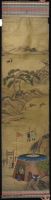
Subject: The artwork illustrates a hunting expedition, which often served as military practice and a display of power for ruling classes. The scene is detailed, showing a combination of a hunting chase (horses and animals in the upper sections) and an organized encampment with figures and a large tent structure in the lower section.
Style and Medium: It appears to be a vertical hanging scroll painted with ink and colors on silk or paper. The detailed brushwork and landscape elements are characteristic of traditional Chinese painting styles.
Origin: The theme of nomadic warriors hunting became a favored subject in the Qing imperial court in China in the late 1600s, and later in the Korean royal court, painted by royal court painters.
Historical Context: Organized hunts were an ancient aristocratic pastime and functioned as a rehearsal for battle, displaying military prowess and organizational skills.
historical East Asian painting, very likely Chinese, that depicts a hunting scene and encampment. It is a style and subject that was popular in Chinese imperial and Korean royal courts from the 17th to 19th centuries.
Artwork Details
Subject: The artwork illustrates a hunting expedition, which often served as military practice and a display of power for ruling classes. The scene is detailed, showing a combination of a hunting chase (horses and animals in the upper sections) and an organized encampment with figures and a large tent structure in the lower section.
Style and Medium: It appears to be a vertical hanging scroll painted with ink and colors on silk or paper. The detailed brushwork and landscape elements are characteristic of traditional Chinese painting styles.
Origin: The theme of nomadic warriors hunting became a favored subject in the Qing imperial court in China in the late 1600s, and later in the Korean royal court, painted by royal court painters.
Historical Context: Organized hunts were an ancient aristocratic pastime and functioned as a rehearsal for battle, displaying military prowess and organizational skills.
After

Verso after


Disclaimer
The object and/or subject of this report is private property. This page is for informational purposes only. Unless clearly stated otherwise, all conservation and restoration has been performed by Poster Mountain (PM) or Los Angeles Paper Group (LAPG)I) PM-LAPG has not knowingly withheld any significant information from its evaluation report and to the best of its knowledge all statements and evaluations in this report are true and correct.
II) PM-LAPG stated in the Evaluation Report its own personal, unbiased and professional analysis, opinions and conclusions, which are subject to the assumptions and limited conditions in this evaluation report as set forth hereinabove.
III) PM-LAPG has no present or prospective interests in the property which is the subject matter of this report and it has no present or prospective personal interests or bias with respect to the participants in this matter.
IV) PM-LAPG and its employment and/or compensation for performing this evaluation or any future anticipated evaluation was not conditioned on any agreement or understanding, written or otherwise, that it would report (or present analysis in support) as predetermined specific authenticity, a predetermined evaluation that favors the cause of any party or the attainment of any specific result or occurrence of a specific subsequent event, such as value or marketability.
V) PM-LAPG prepared all opinions and conclusions about the subject property that were set forth in this Evaluation Report. If it has relied on significant evaluation assistance from any individual or individuals in the performance of this evaluation or the appropriation of this evaluation report, PM-LAPG has named such individuals and disclosed the specific task performed in this evaluation report. PM-LAPG certifies that any individual so named is qualified to the same extent as PM to perform the task. PM-LAPG has not authorized anyone to make a change to any item in this evaluation report, therefore, any change made to this evaluation is unauthorized and PM-LAPG will not take responsibility for it.
VI) The Client may not disclose or distribute this Evaluation Report to any potential purchasers of the subject property without first obtaining PM-LAPG's prior written consent. This consent must be obtained before this evaluation report may be disclosed or distributed to any other party, including, but not limited to, the public through advertising, public relations, news, sales, or other media.