
Strasbourg
Chin Colle'
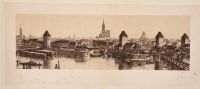
handsigned etching by the artist Albert Koerttge, created in 1919. The artwork is titled Strasbourg or Aux Ponts-Couverts and depicts a view over the Ill river of the city and its cathedral in the background.
Artwork Details
Artist: Albert Koerttge (1861-1940), an architect by training who became a full-time painter and engraver.
Location Depicted: The image shows the Ponts Couverts (Covered Bridges), a set of three bridges and four towers that formed a medieval defensive work on the River Ill in the historic Petite France quarter of Strasbourg, France.
Medium: Etching/Radierung (German for etching).
Date: 1919. This date is significant as Strasbourg was returned to France from German control after World War I. Chine collé
is a printmaking technique where a thin sheet of paper is bonded to a heavier support paper during the printing process itself. The term roughly translates from French as "Chinese glued" because the delicate paper traditionally used was imported from China, Japan, or India.
Purpose and Effects
Fine Detail: The delicate surface of the thin paper (often washi or tissue) can capture much finer details from the inked plate than a typical heavy printmaking paper.
Color and Texture: Artists use chine collé to introduce different colors, textures, or even patterns to specific areas of a print, without needing a separate printing block for color.
Aesthetic Qualities: The technique results in a subtle, refined, or sometimes embossed appearance, contrasting the texture of the adhered paper with the main backing sheet.
The Process
The key feature of chine collé is that the layers are run through the press simultaneously, ensuring a strong, integral bond:
Preparation: A printing plate (from etching, lithography, or other methods) is inked as usual.
Layering: A piece of dampened, tissue-thin paper, often with a thin layer of starch-based adhesive applied, is placed on the inked plate.
Bonding: A larger, thicker backing paper is placed on top of the tissue paper.
Pressing: The entire assembly (plate, thin paper, glue, and support paper) is run through the high-pressure printing press. The pressure transfers the ink to the top layer of paper while simultaneously adhering it permanently to the thicker backing sheet.
handsigned etching by the artist Albert Koerttge, created in 1919. The artwork is titled Strasbourg or Aux Ponts-Couverts and depicts a view over the Ill river of the city and its cathedral in the background.
Artwork Details
Artist: Albert Koerttge (1861-1940), an architect by training who became a full-time painter and engraver.
Location Depicted: The image shows the Ponts Couverts (Covered Bridges), a set of three bridges and four towers that formed a medieval defensive work on the River Ill in the historic Petite France quarter of Strasbourg, France.
Medium: Etching/Radierung (German for etching).
Date: 1919. This date is significant as Strasbourg was returned to France from German control after World War I. Chine collé
is a printmaking technique where a thin sheet of paper is bonded to a heavier support paper during the printing process itself. The term roughly translates from French as "Chinese glued" because the delicate paper traditionally used was imported from China, Japan, or India.
Purpose and Effects
Fine Detail: The delicate surface of the thin paper (often washi or tissue) can capture much finer details from the inked plate than a typical heavy printmaking paper.
Color and Texture: Artists use chine collé to introduce different colors, textures, or even patterns to specific areas of a print, without needing a separate printing block for color.
Aesthetic Qualities: The technique results in a subtle, refined, or sometimes embossed appearance, contrasting the texture of the adhered paper with the main backing sheet.
The Process
The key feature of chine collé is that the layers are run through the press simultaneously, ensuring a strong, integral bond:
Preparation: A printing plate (from etching, lithography, or other methods) is inked as usual.
Layering: A piece of dampened, tissue-thin paper, often with a thin layer of starch-based adhesive applied, is placed on the inked plate.
Bonding: A larger, thicker backing paper is placed on top of the tissue paper.
Pressing: The entire assembly (plate, thin paper, glue, and support paper) is run through the high-pressure printing press. The pressure transfers the ink to the top layer of paper while simultaneously adhering it permanently to the thicker backing sheet.

After
Disclaimer
The object and/or subject of this report is private property. This page is for informational purposes only. Unless clearly stated otherwise, all conservation and restoration has been performed by Poster Mountain (PM) or Los Angeles Paper Group (LAPG)I) PM-LAPG has not knowingly withheld any significant information from its evaluation report and to the best of its knowledge all statements and evaluations in this report are true and correct.
II) PM-LAPG stated in the Evaluation Report its own personal, unbiased and professional analysis, opinions and conclusions, which are subject to the assumptions and limited conditions in this evaluation report as set forth hereinabove.
III) PM-LAPG has no present or prospective interests in the property which is the subject matter of this report and it has no present or prospective personal interests or bias with respect to the participants in this matter.
IV) PM-LAPG and its employment and/or compensation for performing this evaluation or any future anticipated evaluation was not conditioned on any agreement or understanding, written or otherwise, that it would report (or present analysis in support) as predetermined specific authenticity, a predetermined evaluation that favors the cause of any party or the attainment of any specific result or occurrence of a specific subsequent event, such as value or marketability.
V) PM-LAPG prepared all opinions and conclusions about the subject property that were set forth in this Evaluation Report. If it has relied on significant evaluation assistance from any individual or individuals in the performance of this evaluation or the appropriation of this evaluation report, PM-LAPG has named such individuals and disclosed the specific task performed in this evaluation report. PM-LAPG certifies that any individual so named is qualified to the same extent as PM to perform the task. PM-LAPG has not authorized anyone to make a change to any item in this evaluation report, therefore, any change made to this evaluation is unauthorized and PM-LAPG will not take responsibility for it.
VI) The Client may not disclose or distribute this Evaluation Report to any potential purchasers of the subject property without first obtaining PM-LAPG's prior written consent. This consent must be obtained before this evaluation report may be disclosed or distributed to any other party, including, but not limited to, the public through advertising, public relations, news, sales, or other media.