
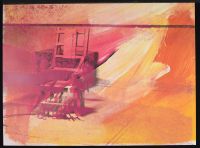
The Electric Chair, 1971
Fine art screenprint by Andy Warhol
Electric Chair series created by Andy Warhol in 1971. This specific print features the iconic empty electric chair image in vibrant pink and orange/yellow hues.
Artwork Details
Artist: Andy Warhol (American, 1928–1987)
Title: Electric Chair (part of a portfolio of ten screenprints)
Date: 1971
Medium: Screenprint in colors on wove paper
Dimensions: Approximately 35 ½ x 48 inches (90 x 121.9 cm)
Edition: Typically an edition of 250 numbered copies, plus artist's proofs
Meaning and Context
The Electric Chair series is part of Warhol's broader "Death and Disaster" body of work, which he started in the early 1960s.
Source Image: Warhol appropriated the image from a press photograph of the empty death chamber at Sing Sing Prison in New York.
Social Commentary: The image directly references the controversial subject of capital punishment, particularly the high-profile execution of Julius and Ethel Rosenberg in 1953. New York State abolished capital punishment shortly after in 1963, a context relevant to the series' inception.
Artistic Style: By depicting a stark and gruesome subject with vivid, "pretty" colors and mass-production techniques like silkscreen printing, Warhol explores themes of media desensitization, mortality, and the intersection of violence with popular culture. The empty chair serves as a powerful, haunting symbol of absence and state-sanctioned death.
Electric Chair series created by Andy Warhol in 1971. This specific print features the iconic empty electric chair image in vibrant pink and orange/yellow hues.
Artwork Details
Artist: Andy Warhol (American, 1928–1987)
Title: Electric Chair (part of a portfolio of ten screenprints)
Date: 1971
Medium: Screenprint in colors on wove paper
Dimensions: Approximately 35 ½ x 48 inches (90 x 121.9 cm)
Edition: Typically an edition of 250 numbered copies, plus artist's proofs
Meaning and Context
The Electric Chair series is part of Warhol's broader "Death and Disaster" body of work, which he started in the early 1960s.
Source Image: Warhol appropriated the image from a press photograph of the empty death chamber at Sing Sing Prison in New York.
Social Commentary: The image directly references the controversial subject of capital punishment, particularly the high-profile execution of Julius and Ethel Rosenberg in 1953. New York State abolished capital punishment shortly after in 1963, a context relevant to the series' inception.
Artistic Style: By depicting a stark and gruesome subject with vivid, "pretty" colors and mass-production techniques like silkscreen printing, Warhol explores themes of media desensitization, mortality, and the intersection of violence with popular culture. The empty chair serves as a powerful, haunting symbol of absence and state-sanctioned death.
Disclaimer
The object and/or subject of this report is private property. This page is for informational purposes only. Unless clearly stated otherwise, all conservation and restoration has been performed by Poster Mountain (PM) or Los Angeles Paper Group (LAPG)I) PM-LAPG has not knowingly withheld any significant information from its evaluation report and to the best of its knowledge all statements and evaluations in this report are true and correct.
II) PM-LAPG stated in the Evaluation Report its own personal, unbiased and professional analysis, opinions and conclusions, which are subject to the assumptions and limited conditions in this evaluation report as set forth hereinabove.
III) PM-LAPG has no present or prospective interests in the property which is the subject matter of this report and it has no present or prospective personal interests or bias with respect to the participants in this matter.
IV) PM-LAPG and its employment and/or compensation for performing this evaluation or any future anticipated evaluation was not conditioned on any agreement or understanding, written or otherwise, that it would report (or present analysis in support) as predetermined specific authenticity, a predetermined evaluation that favors the cause of any party or the attainment of any specific result or occurrence of a specific subsequent event, such as value or marketability.
V) PM-LAPG prepared all opinions and conclusions about the subject property that were set forth in this Evaluation Report. If it has relied on significant evaluation assistance from any individual or individuals in the performance of this evaluation or the appropriation of this evaluation report, PM-LAPG has named such individuals and disclosed the specific task performed in this evaluation report. PM-LAPG certifies that any individual so named is qualified to the same extent as PM to perform the task. PM-LAPG has not authorized anyone to make a change to any item in this evaluation report, therefore, any change made to this evaluation is unauthorized and PM-LAPG will not take responsibility for it.
VI) The Client may not disclose or distribute this Evaluation Report to any potential purchasers of the subject property without first obtaining PM-LAPG's prior written consent. This consent must be obtained before this evaluation report may be disclosed or distributed to any other party, including, but not limited to, the public through advertising, public relations, news, sales, or other media.