
Citizen Kane
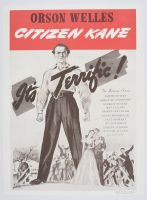
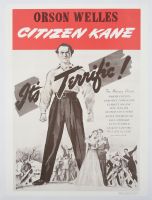
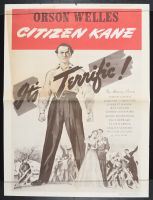
Half sheet reissue vintage movie poster for the 1941 cinematic masterpiece
Citizen Kane, directed by and starring Orson Welles. Widely regarded as one of the greatest films ever made, it is celebrated for its groundbreaking technical innovations and complex narrative structure.
Plot Summary
The film centers on the rise and fall of publishing tycoon Charles Foster Kane. Following his death, a reporter is tasked with uncovering the meaning of his enigmatic final word: "Rosebud".
Narrative Structure: The story is told through a series of non-chronological flashbacks as the reporter interviews Kane's former associates, including his best friend Jedediah Leland and his second wife Susan Alexander.
The "Rosebud" Mystery: At the film's conclusion, it is revealed to the audience (but not the characters) that "Rosebud" was the name of the childhood sled Kane was playing with the day he was taken from his family. It symbolizes the innocence and happiness he lost in his pursuit of wealth and power.
Why It Is Important
Technical Innovation: The film revolutionized cinema with its use of deep focus (keeping both foreground and background in sharp focus), low-angle shots, innovative lighting, and complex sound design.
Cinematic Legacy: It topped the American Film Institute's "100 Years... 100 Movies" list in both 1998 and 2007 and was ranked number one in the British Film Institute's Sight and Sound critics' poll for 40 years.
Controversy: The character of Kane was famously a composite based on real-life media barons, most notably William Randolph Hearst, who was so offended by the depiction that he attempted to suppress the film's release.
Key Cast Members
The poster lists "The Mercury Actors," many of whom made their film debuts in this production:
Joseph Cotten as Jedediah Leland
Dorothy Comingore as Susan Alexander
Everett Sloane as Mr. Bernstein
Agnes Moorehead as Mary Kane
Citizen Kane, directed by and starring Orson Welles. Widely regarded as one of the greatest films ever made, it is celebrated for its groundbreaking technical innovations and complex narrative structure.
Plot Summary
The film centers on the rise and fall of publishing tycoon Charles Foster Kane. Following his death, a reporter is tasked with uncovering the meaning of his enigmatic final word: "Rosebud".
Narrative Structure: The story is told through a series of non-chronological flashbacks as the reporter interviews Kane's former associates, including his best friend Jedediah Leland and his second wife Susan Alexander.
The "Rosebud" Mystery: At the film's conclusion, it is revealed to the audience (but not the characters) that "Rosebud" was the name of the childhood sled Kane was playing with the day he was taken from his family. It symbolizes the innocence and happiness he lost in his pursuit of wealth and power.
Why It Is Important
Technical Innovation: The film revolutionized cinema with its use of deep focus (keeping both foreground and background in sharp focus), low-angle shots, innovative lighting, and complex sound design.
Cinematic Legacy: It topped the American Film Institute's "100 Years... 100 Movies" list in both 1998 and 2007 and was ranked number one in the British Film Institute's Sight and Sound critics' poll for 40 years.
Controversy: The character of Kane was famously a composite based on real-life media barons, most notably William Randolph Hearst, who was so offended by the depiction that he attempted to suppress the film's release.
Key Cast Members
The poster lists "The Mercury Actors," many of whom made their film debuts in this production:
Joseph Cotten as Jedediah Leland
Dorothy Comingore as Susan Alexander
Everett Sloane as Mr. Bernstein
Agnes Moorehead as Mary Kane
After
Mounted
Disclaimer
The object and/or subject of this report is private property. This page is for informational purposes only. Unless clearly stated otherwise, all conservation and restoration has been performed by Poster Mountain (PM) or Los Angeles Paper Group (LAPG)I) PM-LAPG has not knowingly withheld any significant information from its evaluation report and to the best of its knowledge all statements and evaluations in this report are true and correct.
II) PM-LAPG stated in the Evaluation Report its own personal, unbiased and professional analysis, opinions and conclusions, which are subject to the assumptions and limited conditions in this evaluation report as set forth hereinabove.
III) PM-LAPG has no present or prospective interests in the property which is the subject matter of this report and it has no present or prospective personal interests or bias with respect to the participants in this matter.
IV) PM-LAPG and its employment and/or compensation for performing this evaluation or any future anticipated evaluation was not conditioned on any agreement or understanding, written or otherwise, that it would report (or present analysis in support) as predetermined specific authenticity, a predetermined evaluation that favors the cause of any party or the attainment of any specific result or occurrence of a specific subsequent event, such as value or marketability.
V) PM-LAPG prepared all opinions and conclusions about the subject property that were set forth in this Evaluation Report. If it has relied on significant evaluation assistance from any individual or individuals in the performance of this evaluation or the appropriation of this evaluation report, PM-LAPG has named such individuals and disclosed the specific task performed in this evaluation report. PM-LAPG certifies that any individual so named is qualified to the same extent as PM to perform the task. PM-LAPG has not authorized anyone to make a change to any item in this evaluation report, therefore, any change made to this evaluation is unauthorized and PM-LAPG will not take responsibility for it.
VI) The Client may not disclose or distribute this Evaluation Report to any potential purchasers of the subject property without first obtaining PM-LAPG's prior written consent. This consent must be obtained before this evaluation report may be disclosed or distributed to any other party, including, but not limited to, the public through advertising, public relations, news, sales, or other media.