
Dr. Strangelove
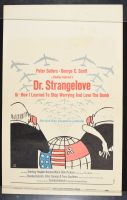
Window Card window card for Dr. Strangelove.
Window Card Specifications
A window card is a specific type of theatrical poster with the following characteristics:
Dimensions: Standard window cards typically measure 14" x 22". Some variants, such as those that have been "trimmed," may measure around 14" x 17".
Material: Unlike standard paper posters (such as one-sheets), window cards are printed on a heavier cardstock.
Purpose: They were originally designed to be displayed in local store windows, barber shops, or dental offices.
Unique Feature: They typically feature a blank white border (approximately 4 to 6 inches) at the top. This space was intended for the local theater to write in showtimes and their own name.
Dr. Strangelove or: How I Learned to Stop Worrying and Love the Bomb
is a 1964 satirical black comedy directed by Stanley Kubrick that parodies the Cold War fears of a nuclear conflict between the U.S. and the Soviet Union.
Synopsis
The story follows unhinged U.S. Air Force General Jack D. Ripper, who bypasses the President to order a preemptive nuclear strike on the USSR, believing communists are conspiring to pollute American "precious bodily fluids". The film splits its focus between three main locations as the world hurtles toward destruction:
The War Room: Where President Merkin Muffley, his advisors, and the hawkish General Buck Turgidson frantically try to stop the attack.
A B-52 Bomber: Where the crew, led by Major "King" Kong, attempts to deliver its payload despite damaged communications.
Burpelson Air Force Base: Where British RAF officer Lionel Mandrake attempts to extract the recall code from General Ripper.
Key Performances and Roles
The film is famous for Peter Sellers playing three distinct roles:
Group Captain Lionel Mandrake: A polite, stressed British officer trying to prevent the launch.
President Merkin Muffley: A serious, Midwestern American leader modeled after Adlai Stevenson.
Dr. Strangelove: An eccentric, wheelchair-bound former Nazi scientist with an uncontrollable mechanical arm.
Other notable roles include George C. Scott as the gung-ho General Turgidson and Slim Pickens as Major Kong, who famously rides a nuclear bomb down to its target.
Cultural Impact and Themes
Satire of MAD: The film critiques the policy of Mutually Assured Destruction, culminating in the revelation of a Soviet "Doomsday Machine" designed to automatically destroy all life if Russia is attacked.
Historical Context: Released shortly after the 1962 Cuban Missile Crisis, it tapped into real anxieties about accidental nuclear war.
Legacy: It is consistently ranked as one of the greatest comedies in cinema history and was among the first films selected for preservation in the National Film Registry.
Window Card Specifications
A window card is a specific type of theatrical poster with the following characteristics:
Dimensions: Standard window cards typically measure 14" x 22". Some variants, such as those that have been "trimmed," may measure around 14" x 17".
Material: Unlike standard paper posters (such as one-sheets), window cards are printed on a heavier cardstock.
Purpose: They were originally designed to be displayed in local store windows, barber shops, or dental offices.
Unique Feature: They typically feature a blank white border (approximately 4 to 6 inches) at the top. This space was intended for the local theater to write in showtimes and their own name.
Dr. Strangelove or: How I Learned to Stop Worrying and Love the Bomb
is a 1964 satirical black comedy directed by Stanley Kubrick that parodies the Cold War fears of a nuclear conflict between the U.S. and the Soviet Union.
Synopsis
The story follows unhinged U.S. Air Force General Jack D. Ripper, who bypasses the President to order a preemptive nuclear strike on the USSR, believing communists are conspiring to pollute American "precious bodily fluids". The film splits its focus between three main locations as the world hurtles toward destruction:
The War Room: Where President Merkin Muffley, his advisors, and the hawkish General Buck Turgidson frantically try to stop the attack.
A B-52 Bomber: Where the crew, led by Major "King" Kong, attempts to deliver its payload despite damaged communications.
Burpelson Air Force Base: Where British RAF officer Lionel Mandrake attempts to extract the recall code from General Ripper.
Key Performances and Roles
The film is famous for Peter Sellers playing three distinct roles:
Group Captain Lionel Mandrake: A polite, stressed British officer trying to prevent the launch.
President Merkin Muffley: A serious, Midwestern American leader modeled after Adlai Stevenson.
Dr. Strangelove: An eccentric, wheelchair-bound former Nazi scientist with an uncontrollable mechanical arm.
Other notable roles include George C. Scott as the gung-ho General Turgidson and Slim Pickens as Major Kong, who famously rides a nuclear bomb down to its target.
Cultural Impact and Themes
Satire of MAD: The film critiques the policy of Mutually Assured Destruction, culminating in the revelation of a Soviet "Doomsday Machine" designed to automatically destroy all life if Russia is attacked.
Historical Context: Released shortly after the 1962 Cuban Missile Crisis, it tapped into real anxieties about accidental nuclear war.
Legacy: It is consistently ranked as one of the greatest comedies in cinema history and was among the first films selected for preservation in the National Film Registry.
Disclaimer
The object and/or subject of this report is private property. This page is for informational purposes only. Unless clearly stated otherwise, all conservation and restoration has been performed by Poster Mountain (PM) or Los Angeles Paper Group (LAPG)I) PM-LAPG has not knowingly withheld any significant information from its evaluation report and to the best of its knowledge all statements and evaluations in this report are true and correct.
II) PM-LAPG stated in the Evaluation Report its own personal, unbiased and professional analysis, opinions and conclusions, which are subject to the assumptions and limited conditions in this evaluation report as set forth hereinabove.
III) PM-LAPG has no present or prospective interests in the property which is the subject matter of this report and it has no present or prospective personal interests or bias with respect to the participants in this matter.
IV) PM-LAPG and its employment and/or compensation for performing this evaluation or any future anticipated evaluation was not conditioned on any agreement or understanding, written or otherwise, that it would report (or present analysis in support) as predetermined specific authenticity, a predetermined evaluation that favors the cause of any party or the attainment of any specific result or occurrence of a specific subsequent event, such as value or marketability.
V) PM-LAPG prepared all opinions and conclusions about the subject property that were set forth in this Evaluation Report. If it has relied on significant evaluation assistance from any individual or individuals in the performance of this evaluation or the appropriation of this evaluation report, PM-LAPG has named such individuals and disclosed the specific task performed in this evaluation report. PM-LAPG certifies that any individual so named is qualified to the same extent as PM to perform the task. PM-LAPG has not authorized anyone to make a change to any item in this evaluation report, therefore, any change made to this evaluation is unauthorized and PM-LAPG will not take responsibility for it.
VI) The Client may not disclose or distribute this Evaluation Report to any potential purchasers of the subject property without first obtaining PM-LAPG's prior written consent. This consent must be obtained before this evaluation report may be disclosed or distributed to any other party, including, but not limited to, the public through advertising, public relations, news, sales, or other media.