
Orphee
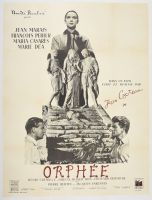
French 1 panel poster is for the 1950 French film
Orphée (Orpheus), written and directed by the legendary Jean Cocteau. It is a surreal, modern retelling of the Greek myth of Orpheus and Eurydice, set in post-war Paris.
Film Overview
The story follows Orphée (Jean Marais), a famous poet who becomes obsessed with a mysterious Princess (María Casares) who is a personification of Death. This obsession leads him to neglect his wife, Eurydice (Marie Déa). After Eurydice is killed, Orphée travels to the Underworld to reclaim her, but he is torn between his human wife and his supernatural love for Death.
Key Creative Elements
The Mirror Portal: One of the film's most iconic symbols is the use of mirrors as "gates" through which death comes and goes. To film characters passing through them, Cocteau used a vat of mercury to create a molten, reflective effect.
The Radio Messages: Orphée becomes captivated by cryptic, poetic phrases broadcast over a car radio, which he believes are a source of fresh inspiration.
The Orphic Trilogy: This film is the central part of Cocteau's trilogy, which includes The Blood of a Poet (1930) and Testament of Orpheus (1960).
Cast and Production
Role Actor
Orphée Jean Marais
The Princess (Death) María Casares
Heurtebise (The chauffeur) François Périer
Eurydice Marie Déa
Cégeste (Young poet) Edouard Dermithe
The film's score was composed by Georges Auric, and the cinematography was by Nicolas Hayer.
Orphée (Orpheus), written and directed by the legendary Jean Cocteau. It is a surreal, modern retelling of the Greek myth of Orpheus and Eurydice, set in post-war Paris.
Film Overview
The story follows Orphée (Jean Marais), a famous poet who becomes obsessed with a mysterious Princess (María Casares) who is a personification of Death. This obsession leads him to neglect his wife, Eurydice (Marie Déa). After Eurydice is killed, Orphée travels to the Underworld to reclaim her, but he is torn between his human wife and his supernatural love for Death.
Key Creative Elements
The Mirror Portal: One of the film's most iconic symbols is the use of mirrors as "gates" through which death comes and goes. To film characters passing through them, Cocteau used a vat of mercury to create a molten, reflective effect.
The Radio Messages: Orphée becomes captivated by cryptic, poetic phrases broadcast over a car radio, which he believes are a source of fresh inspiration.
The Orphic Trilogy: This film is the central part of Cocteau's trilogy, which includes The Blood of a Poet (1930) and Testament of Orpheus (1960).
Cast and Production
Role Actor
Orphée Jean Marais
The Princess (Death) María Casares
Heurtebise (The chauffeur) François Périer
Eurydice Marie Déa
Cégeste (Young poet) Edouard Dermithe
The film's score was composed by Georges Auric, and the cinematography was by Nicolas Hayer.
Mounted
Disclaimer
The object and/or subject of this report is private property. This page is for informational purposes only. Unless clearly stated otherwise, all conservation and restoration has been performed by Poster Mountain (PM) or Los Angeles Paper Group (LAPG)I) PM-LAPG has not knowingly withheld any significant information from its evaluation report and to the best of its knowledge all statements and evaluations in this report are true and correct.
II) PM-LAPG stated in the Evaluation Report its own personal, unbiased and professional analysis, opinions and conclusions, which are subject to the assumptions and limited conditions in this evaluation report as set forth hereinabove.
III) PM-LAPG has no present or prospective interests in the property which is the subject matter of this report and it has no present or prospective personal interests or bias with respect to the participants in this matter.
IV) PM-LAPG and its employment and/or compensation for performing this evaluation or any future anticipated evaluation was not conditioned on any agreement or understanding, written or otherwise, that it would report (or present analysis in support) as predetermined specific authenticity, a predetermined evaluation that favors the cause of any party or the attainment of any specific result or occurrence of a specific subsequent event, such as value or marketability.
V) PM-LAPG prepared all opinions and conclusions about the subject property that were set forth in this Evaluation Report. If it has relied on significant evaluation assistance from any individual or individuals in the performance of this evaluation or the appropriation of this evaluation report, PM-LAPG has named such individuals and disclosed the specific task performed in this evaluation report. PM-LAPG certifies that any individual so named is qualified to the same extent as PM to perform the task. PM-LAPG has not authorized anyone to make a change to any item in this evaluation report, therefore, any change made to this evaluation is unauthorized and PM-LAPG will not take responsibility for it.
VI) The Client may not disclose or distribute this Evaluation Report to any potential purchasers of the subject property without first obtaining PM-LAPG's prior written consent. This consent must be obtained before this evaluation report may be disclosed or distributed to any other party, including, but not limited to, the public through advertising, public relations, news, sales, or other media.