
See Scotland by Train Elgin Cathedral
One sheet vintage
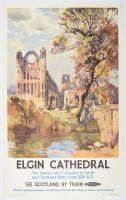
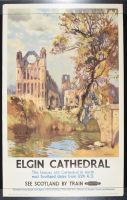
British Railways travel poster promoting Elgin Cathedral in north-east Scotland. Originally designed by the artist Jack Merriott in the 1950s, the poster was part of the "See Scotland by Train" campaign to encourage travel along the Aberdeen-to-Inverness line.
Historic "Lantern of the North"
Elgin Cathedral is a historic ruin dedicated to the Holy Trinity. It earned the nickname "Lantern of the North" due to its magnificent appearance and large windows that once glowed like a beacon across the Moray landscape.
Foundation: Established in 1224 on land granted by King Alexander II.
Destruction: It suffered significant damage over centuries, most notably being burned in 1390 by Alexander Stewart, the "Wolf of Badenoch," during a dispute with the Bishop of Moray.
Decline: After the Scottish Reformation in 1560, the cathedral was abandoned. Its lead roof was removed in 1567 to fund the army, leading to rapid decay, and the central tower finally collapsed in 1711.
Visiting Today
While the cathedral is no longer a place of worship, it is a popular visitor attraction managed by Historic Environment Scotland.
Key Sights: Visitors can see the remarkably complete 13th-century west front, the octagonal chapter house with its intricate stone carvings, and a 9th-century Pictish cross-slab.
Experience: You can climb the spiral stairs of the north-west tower for panoramic views of the town of Elgin.
Nearby: Just across from the ruins is the Elgin Biblical Garden, a quiet space featuring plants mentioned in the Bible.
British Railways travel poster promoting Elgin Cathedral in north-east Scotland. Originally designed by the artist Jack Merriott in the 1950s, the poster was part of the "See Scotland by Train" campaign to encourage travel along the Aberdeen-to-Inverness line.
Historic "Lantern of the North"
Elgin Cathedral is a historic ruin dedicated to the Holy Trinity. It earned the nickname "Lantern of the North" due to its magnificent appearance and large windows that once glowed like a beacon across the Moray landscape.
Foundation: Established in 1224 on land granted by King Alexander II.
Destruction: It suffered significant damage over centuries, most notably being burned in 1390 by Alexander Stewart, the "Wolf of Badenoch," during a dispute with the Bishop of Moray.
Decline: After the Scottish Reformation in 1560, the cathedral was abandoned. Its lead roof was removed in 1567 to fund the army, leading to rapid decay, and the central tower finally collapsed in 1711.
Visiting Today
While the cathedral is no longer a place of worship, it is a popular visitor attraction managed by Historic Environment Scotland.
Key Sights: Visitors can see the remarkably complete 13th-century west front, the octagonal chapter house with its intricate stone carvings, and a 9th-century Pictish cross-slab.
Experience: You can climb the spiral stairs of the north-west tower for panoramic views of the town of Elgin.
Nearby: Just across from the ruins is the Elgin Biblical Garden, a quiet space featuring plants mentioned in the Bible.
Mounted
Disclaimer
The object and/or subject of this report is private property. This page is for informational purposes only. Unless clearly stated otherwise, all conservation and restoration has been performed by Poster Mountain (PM) or Los Angeles Paper Group (LAPG)I) PM-LAPG has not knowingly withheld any significant information from its evaluation report and to the best of its knowledge all statements and evaluations in this report are true and correct.
II) PM-LAPG stated in the Evaluation Report its own personal, unbiased and professional analysis, opinions and conclusions, which are subject to the assumptions and limited conditions in this evaluation report as set forth hereinabove.
III) PM-LAPG has no present or prospective interests in the property which is the subject matter of this report and it has no present or prospective personal interests or bias with respect to the participants in this matter.
IV) PM-LAPG and its employment and/or compensation for performing this evaluation or any future anticipated evaluation was not conditioned on any agreement or understanding, written or otherwise, that it would report (or present analysis in support) as predetermined specific authenticity, a predetermined evaluation that favors the cause of any party or the attainment of any specific result or occurrence of a specific subsequent event, such as value or marketability.
V) PM-LAPG prepared all opinions and conclusions about the subject property that were set forth in this Evaluation Report. If it has relied on significant evaluation assistance from any individual or individuals in the performance of this evaluation or the appropriation of this evaluation report, PM-LAPG has named such individuals and disclosed the specific task performed in this evaluation report. PM-LAPG certifies that any individual so named is qualified to the same extent as PM to perform the task. PM-LAPG has not authorized anyone to make a change to any item in this evaluation report, therefore, any change made to this evaluation is unauthorized and PM-LAPG will not take responsibility for it.
VI) The Client may not disclose or distribute this Evaluation Report to any potential purchasers of the subject property without first obtaining PM-LAPG's prior written consent. This consent must be obtained before this evaluation report may be disclosed or distributed to any other party, including, but not limited to, the public through advertising, public relations, news, sales, or other media.