
George The Supreme Master Of Magic
8 sheet magic poster iconic vintage poster features the magician
Grover George (1887–1958), an Ohio native who performed under the stage name "George, The Supreme Master of Magic".
The History of the Poster
The artwork was created around 1924–1929 by the Otis Lithograph Company in Cleveland, Ohio. It was intended to promote George's "Triumphant American Tour," which he hoped would establish him as a premier act in the United States after a highly successful multi-year tour of Cuba, Central, and South America.
However, the tour was largely derailed by the legendary magician Howard Thurston, who viewed George as a threat. Thurston used his influence to pressure theater managers, threatening to never perform at their venues if they booked George. This forced George to perform in second-rate theaters and eventually led him to return to South America, where he spent the rest of his life.
Because the American tour never fully materialized, thousands of these pristine posters were never used. They were discovered decades later, in the 1980s, stored in a barn in Berlin, Wisconsin, which is why so many high-quality originals and reproductions exist today.
Visual Elements
The poster is celebrated for its "Golden Age" lithographic style, featuring:
George himself in a classic tuxedo, seemingly "streaming" a deck of cards from his hand.
Exotic Imagery: Symbols of "Oriental mysticism" and "Egyptian mystery," including the Sphinx, pyramids, and camels.
Supernatural motifs: Demonic imps, skeletons, and a "menacing devil" to evoke a sense of otherworldly power.
The "18 People" Claim: A common marketing tactic of the era to emphasize the grand scale of the production.
Grover George (1887–1958), an Ohio native who performed under the stage name "George, The Supreme Master of Magic".
The History of the Poster
The artwork was created around 1924–1929 by the Otis Lithograph Company in Cleveland, Ohio. It was intended to promote George's "Triumphant American Tour," which he hoped would establish him as a premier act in the United States after a highly successful multi-year tour of Cuba, Central, and South America.
However, the tour was largely derailed by the legendary magician Howard Thurston, who viewed George as a threat. Thurston used his influence to pressure theater managers, threatening to never perform at their venues if they booked George. This forced George to perform in second-rate theaters and eventually led him to return to South America, where he spent the rest of his life.
Because the American tour never fully materialized, thousands of these pristine posters were never used. They were discovered decades later, in the 1980s, stored in a barn in Berlin, Wisconsin, which is why so many high-quality originals and reproductions exist today.
Visual Elements
The poster is celebrated for its "Golden Age" lithographic style, featuring:
George himself in a classic tuxedo, seemingly "streaming" a deck of cards from his hand.
Exotic Imagery: Symbols of "Oriental mysticism" and "Egyptian mystery," including the Sphinx, pyramids, and camels.
Supernatural motifs: Demonic imps, skeletons, and a "menacing devil" to evoke a sense of otherworldly power.
The "18 People" Claim: A common marketing tactic of the era to emphasize the grand scale of the production.
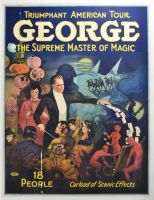
Mounted
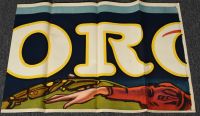
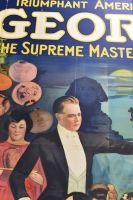
Close up 1
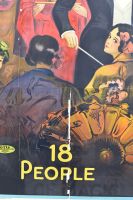
Close up 2
Disclaimer
The object and/or subject of this report is private property. This page is for informational purposes only. Unless clearly stated otherwise, all conservation and restoration has been performed by Poster Mountain (PM) or Los Angeles Paper Group (LAPG)I) PM-LAPG has not knowingly withheld any significant information from its evaluation report and to the best of its knowledge all statements and evaluations in this report are true and correct.
II) PM-LAPG stated in the Evaluation Report its own personal, unbiased and professional analysis, opinions and conclusions, which are subject to the assumptions and limited conditions in this evaluation report as set forth hereinabove.
III) PM-LAPG has no present or prospective interests in the property which is the subject matter of this report and it has no present or prospective personal interests or bias with respect to the participants in this matter.
IV) PM-LAPG and its employment and/or compensation for performing this evaluation or any future anticipated evaluation was not conditioned on any agreement or understanding, written or otherwise, that it would report (or present analysis in support) as predetermined specific authenticity, a predetermined evaluation that favors the cause of any party or the attainment of any specific result or occurrence of a specific subsequent event, such as value or marketability.
V) PM-LAPG prepared all opinions and conclusions about the subject property that were set forth in this Evaluation Report. If it has relied on significant evaluation assistance from any individual or individuals in the performance of this evaluation or the appropriation of this evaluation report, PM-LAPG has named such individuals and disclosed the specific task performed in this evaluation report. PM-LAPG certifies that any individual so named is qualified to the same extent as PM to perform the task. PM-LAPG has not authorized anyone to make a change to any item in this evaluation report, therefore, any change made to this evaluation is unauthorized and PM-LAPG will not take responsibility for it.
VI) The Client may not disclose or distribute this Evaluation Report to any potential purchasers of the subject property without first obtaining PM-LAPG's prior written consent. This consent must be obtained before this evaluation report may be disclosed or distributed to any other party, including, but not limited to, the public through advertising, public relations, news, sales, or other media.