
Are you in This?
Half sheet This iconic British World War I recruitment poster, titled
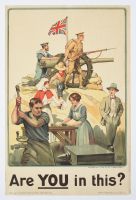
"Are YOU in this?", was designed in 1915 by Robert Baden-Powell, the founder of the Scout Movement.
The poster was published by the Parliamentary Recruiting Committee to encourage voluntary enlistment and civilian support for the war effort before conscription was introduced in 1916.
Symbolism and Meaning
The image depicts a "pyramid" of wartime roles building toward a British flag, symbolizing national unity:
Active Military: At the top, a British soldier in khaki and a Royal Navy sailor manning an artillery gun represent the front-line fighting forces.
The Home Front: Below them, various civilians contribute through labor:
An industrial worker with a sledgehammer and anvil represents heavy industry.
A woman at a table assembles munitions (bullets).
A nurse stands ready to tend to the wounded.
A young Boy Scout carries ammunition, symbolizing the support of British youth.
The "Shirker": On the far right, a fashionably dressed man stands idle with his hands in his pockets, smoking a cigarette. He is the intended target of the poster's question, meant to represent those not yet contributing to the war effort.
Key Facts
Artist: Lieutenant-General Sir Robert Baden-Powell.
Date: Circa 1915.
Purpose: To shame "shirkers" or "city loafers" into joining the war effort by showing that all other segments of society—including women and children—were already doing their part.
"Are YOU in this?", was designed in 1915 by Robert Baden-Powell, the founder of the Scout Movement.
The poster was published by the Parliamentary Recruiting Committee to encourage voluntary enlistment and civilian support for the war effort before conscription was introduced in 1916.
Symbolism and Meaning
The image depicts a "pyramid" of wartime roles building toward a British flag, symbolizing national unity:
Active Military: At the top, a British soldier in khaki and a Royal Navy sailor manning an artillery gun represent the front-line fighting forces.
The Home Front: Below them, various civilians contribute through labor:
An industrial worker with a sledgehammer and anvil represents heavy industry.
A woman at a table assembles munitions (bullets).
A nurse stands ready to tend to the wounded.
A young Boy Scout carries ammunition, symbolizing the support of British youth.
The "Shirker": On the far right, a fashionably dressed man stands idle with his hands in his pockets, smoking a cigarette. He is the intended target of the poster's question, meant to represent those not yet contributing to the war effort.
Key Facts
Artist: Lieutenant-General Sir Robert Baden-Powell.
Date: Circa 1915.
Purpose: To shame "shirkers" or "city loafers" into joining the war effort by showing that all other segments of society—including women and children—were already doing their part.
Mounted
Disclaimer
The object and/or subject of this report is private property. This page is for informational purposes only. Unless clearly stated otherwise, all conservation and restoration has been performed by Poster Mountain (PM) or Los Angeles Paper Group (LAPG)I) PM-LAPG has not knowingly withheld any significant information from its evaluation report and to the best of its knowledge all statements and evaluations in this report are true and correct.
II) PM-LAPG stated in the Evaluation Report its own personal, unbiased and professional analysis, opinions and conclusions, which are subject to the assumptions and limited conditions in this evaluation report as set forth hereinabove.
III) PM-LAPG has no present or prospective interests in the property which is the subject matter of this report and it has no present or prospective personal interests or bias with respect to the participants in this matter.
IV) PM-LAPG and its employment and/or compensation for performing this evaluation or any future anticipated evaluation was not conditioned on any agreement or understanding, written or otherwise, that it would report (or present analysis in support) as predetermined specific authenticity, a predetermined evaluation that favors the cause of any party or the attainment of any specific result or occurrence of a specific subsequent event, such as value or marketability.
V) PM-LAPG prepared all opinions and conclusions about the subject property that were set forth in this Evaluation Report. If it has relied on significant evaluation assistance from any individual or individuals in the performance of this evaluation or the appropriation of this evaluation report, PM-LAPG has named such individuals and disclosed the specific task performed in this evaluation report. PM-LAPG certifies that any individual so named is qualified to the same extent as PM to perform the task. PM-LAPG has not authorized anyone to make a change to any item in this evaluation report, therefore, any change made to this evaluation is unauthorized and PM-LAPG will not take responsibility for it.
VI) The Client may not disclose or distribute this Evaluation Report to any potential purchasers of the subject property without first obtaining PM-LAPG's prior written consent. This consent must be obtained before this evaluation report may be disclosed or distributed to any other party, including, but not limited to, the public through advertising, public relations, news, sales, or other media.