Gateway to Ireland
One sheet vintage poster for
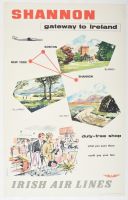
Irish Air Lines (now Aer Lingus) highlights Shannon Airport's historic role as the "Gateway to Ireland." The poster specifically promotes the airport's duty-free shop, which was a revolutionary concept at the time.
The World's First Duty-Free Shop
The duty-free industry was born at Shannon Airport in 1947. It was the brainchild of Dr. Brendan O’Regan, the airport's catering comptroller.
The Idea: O'Regan noticed that transatlantic passengers, who stopped at Shannon to refuel, were in a "legal limbo"—they had technically left one country but not yet entered another. He realized they should be able to buy goods without paying national taxes or duties.
Legislation: He persuaded the Irish government to pass the Customs-Free Airport Act on March 18, 1947, which exempts transit and departing passengers from standard customs procedures.
Early Success: The first shop was a simple kiosk or timber hut. It initially sold local souvenirs, whiskey, and linen. By 1951, it expanded significantly to include more spirits and cigarettes.
Global Impact: Shannon's model was so successful that it was soon replicated worldwide, starting with Amsterdam in 1957.
About the Poster
Artist: This specific poster was designed by Piet Sluis (1929–2008), an Irish Postwar & Contemporary painter.
Date: It was issued in 1959.
Context: By the late 1950s, the Shannon duty-free shop had become a major tourist attraction in its own right, as shown by its prominence alongside destinations like Blarney, Killarney, and Galway the aircraft shown is a
Lockheed Constellation (often nicknamed the "Connie").
Key Features for Identification
The Triple Tail: In the top-left silhouette, you can see the distinctive three-finned tail assembly, which is the most iconic visual signature of the Lockheed Constellation series.
Four Engines: The silhouette shows a four-engine configuration, which was standard for these long-range transatlantic propliners.
Historical Context: Irish Air Lines (Aer Lingus) began its first transatlantic service from Shannon to New York and Boston in 1958 specifically using Lockheed Super Constellations.
The Aircraft's Role
The Constellation was a cornerstone of the "Golden Age" of flight. It allowed Aer Lingus to connect Ireland directly with North American cities like New York and Boston, as illustrated by the red route lines on the poster. This specific model was used for these thrice-weekly services until the airline entered the jet age with Boeing aircraft in 1960.
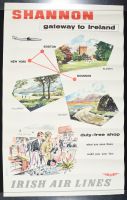
Irish Air Lines (now Aer Lingus) highlights Shannon Airport's historic role as the "Gateway to Ireland." The poster specifically promotes the airport's duty-free shop, which was a revolutionary concept at the time.
The World's First Duty-Free Shop
The duty-free industry was born at Shannon Airport in 1947. It was the brainchild of Dr. Brendan O’Regan, the airport's catering comptroller.
The Idea: O'Regan noticed that transatlantic passengers, who stopped at Shannon to refuel, were in a "legal limbo"—they had technically left one country but not yet entered another. He realized they should be able to buy goods without paying national taxes or duties.
Legislation: He persuaded the Irish government to pass the Customs-Free Airport Act on March 18, 1947, which exempts transit and departing passengers from standard customs procedures.
Early Success: The first shop was a simple kiosk or timber hut. It initially sold local souvenirs, whiskey, and linen. By 1951, it expanded significantly to include more spirits and cigarettes.
Global Impact: Shannon's model was so successful that it was soon replicated worldwide, starting with Amsterdam in 1957.
About the Poster
Artist: This specific poster was designed by Piet Sluis (1929–2008), an Irish Postwar & Contemporary painter.
Date: It was issued in 1959.
Context: By the late 1950s, the Shannon duty-free shop had become a major tourist attraction in its own right, as shown by its prominence alongside destinations like Blarney, Killarney, and Galway the aircraft shown is a
Lockheed Constellation (often nicknamed the "Connie").
Key Features for Identification
The Triple Tail: In the top-left silhouette, you can see the distinctive three-finned tail assembly, which is the most iconic visual signature of the Lockheed Constellation series.
Four Engines: The silhouette shows a four-engine configuration, which was standard for these long-range transatlantic propliners.
Historical Context: Irish Air Lines (Aer Lingus) began its first transatlantic service from Shannon to New York and Boston in 1958 specifically using Lockheed Super Constellations.
The Aircraft's Role
The Constellation was a cornerstone of the "Golden Age" of flight. It allowed Aer Lingus to connect Ireland directly with North American cities like New York and Boston, as illustrated by the red route lines on the poster. This specific model was used for these thrice-weekly services until the airline entered the jet age with Boeing aircraft in 1960.
Mounted
Disclaimer
The object and/or subject of this report is private property. This page is for informational purposes only. Unless clearly stated otherwise, all conservation and restoration has been performed by Poster Mountain (PM) or Los Angeles Paper Group (LAPG)I) PM-LAPG has not knowingly withheld any significant information from its evaluation report and to the best of its knowledge all statements and evaluations in this report are true and correct.
II) PM-LAPG stated in the Evaluation Report its own personal, unbiased and professional analysis, opinions and conclusions, which are subject to the assumptions and limited conditions in this evaluation report as set forth hereinabove.
III) PM-LAPG has no present or prospective interests in the property which is the subject matter of this report and it has no present or prospective personal interests or bias with respect to the participants in this matter.
IV) PM-LAPG and its employment and/or compensation for performing this evaluation or any future anticipated evaluation was not conditioned on any agreement or understanding, written or otherwise, that it would report (or present analysis in support) as predetermined specific authenticity, a predetermined evaluation that favors the cause of any party or the attainment of any specific result or occurrence of a specific subsequent event, such as value or marketability.
V) PM-LAPG prepared all opinions and conclusions about the subject property that were set forth in this Evaluation Report. If it has relied on significant evaluation assistance from any individual or individuals in the performance of this evaluation or the appropriation of this evaluation report, PM-LAPG has named such individuals and disclosed the specific task performed in this evaluation report. PM-LAPG certifies that any individual so named is qualified to the same extent as PM to perform the task. PM-LAPG has not authorized anyone to make a change to any item in this evaluation report, therefore, any change made to this evaluation is unauthorized and PM-LAPG will not take responsibility for it.
VI) The Client may not disclose or distribute this Evaluation Report to any potential purchasers of the subject property without first obtaining PM-LAPG's prior written consent. This consent must be obtained before this evaluation report may be disclosed or distributed to any other party, including, but not limited to, the public through advertising, public relations, news, sales, or other media.