
Solaris
Attraction size Soviet sci-fi movie poster vintage French movie poster for
Solaris (1972), the acclaimed Soviet science fiction film directed by Andrei Tarkovsky.
The Movie: Solaris (1972)
Based on the 1961 novel by Polish author Stanis?aw Lem, the film is a meditative psychological drama.
Plot: Psychologist Kris Kelvin is sent to a space station orbiting the oceanic planet Solaris to investigate why its crew has fallen into emotional crises. He soon discovers the ocean is a sentient intelligence that materializes "visitors"—physical manifestations of the crew's most painful, repressed memories.
Central Conflict: Kelvin is confronted by a replica of his wife, Hari, who died by suicide ten years earlier. The film explores his struggle to distinguish between memory and reality as he falls in love with this non-human "guest".
Significance: Tarkovsky used the film to explore the human condition, memory, and grief. He famously viewed Western science fiction as "shallow" for focusing too much on technology, preferring instead to use the genre as a "mirror" for the human soul.
The Poster Artwork
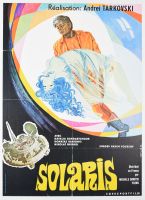
This specific poster was created for the film's French release by Sovexportfilm.
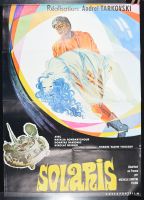
Visual Elements: It depicts Kelvin holding the ghostly, translucent form of Hari, whose long blue hair flows within a colorful cosmic bubble. Below them is the "decrepit" space station orbiting the planet, captured in a style that reflects the film's "groovy" and artistic 1970s aesthetic.
Credits: The poster lists the director as Andrei Tarkovski and highlights the main cast: Natalya Bondarchuk (Hari), Donatas Banionis (Kelvin), and Nikolai Grinko. It also credits the cinematographer, Vadim Yusov.
Solaris (1972), the acclaimed Soviet science fiction film directed by Andrei Tarkovsky.
The Movie: Solaris (1972)
Based on the 1961 novel by Polish author Stanis?aw Lem, the film is a meditative psychological drama.
Plot: Psychologist Kris Kelvin is sent to a space station orbiting the oceanic planet Solaris to investigate why its crew has fallen into emotional crises. He soon discovers the ocean is a sentient intelligence that materializes "visitors"—physical manifestations of the crew's most painful, repressed memories.
Central Conflict: Kelvin is confronted by a replica of his wife, Hari, who died by suicide ten years earlier. The film explores his struggle to distinguish between memory and reality as he falls in love with this non-human "guest".
Significance: Tarkovsky used the film to explore the human condition, memory, and grief. He famously viewed Western science fiction as "shallow" for focusing too much on technology, preferring instead to use the genre as a "mirror" for the human soul.
The Poster Artwork
This specific poster was created for the film's French release by Sovexportfilm.
Visual Elements: It depicts Kelvin holding the ghostly, translucent form of Hari, whose long blue hair flows within a colorful cosmic bubble. Below them is the "decrepit" space station orbiting the planet, captured in a style that reflects the film's "groovy" and artistic 1970s aesthetic.
Credits: The poster lists the director as Andrei Tarkovski and highlights the main cast: Natalya Bondarchuk (Hari), Donatas Banionis (Kelvin), and Nikolai Grinko. It also credits the cinematographer, Vadim Yusov.
Mounted
Disclaimer
The object and/or subject of this report is private property. This page is for informational purposes only. Unless clearly stated otherwise, all conservation and restoration has been performed by Poster Mountain (PM) or Los Angeles Paper Group (LAPG)I) PM-LAPG has not knowingly withheld any significant information from its evaluation report and to the best of its knowledge all statements and evaluations in this report are true and correct.
II) PM-LAPG stated in the Evaluation Report its own personal, unbiased and professional analysis, opinions and conclusions, which are subject to the assumptions and limited conditions in this evaluation report as set forth hereinabove.
III) PM-LAPG has no present or prospective interests in the property which is the subject matter of this report and it has no present or prospective personal interests or bias with respect to the participants in this matter.
IV) PM-LAPG and its employment and/or compensation for performing this evaluation or any future anticipated evaluation was not conditioned on any agreement or understanding, written or otherwise, that it would report (or present analysis in support) as predetermined specific authenticity, a predetermined evaluation that favors the cause of any party or the attainment of any specific result or occurrence of a specific subsequent event, such as value or marketability.
V) PM-LAPG prepared all opinions and conclusions about the subject property that were set forth in this Evaluation Report. If it has relied on significant evaluation assistance from any individual or individuals in the performance of this evaluation or the appropriation of this evaluation report, PM-LAPG has named such individuals and disclosed the specific task performed in this evaluation report. PM-LAPG certifies that any individual so named is qualified to the same extent as PM to perform the task. PM-LAPG has not authorized anyone to make a change to any item in this evaluation report, therefore, any change made to this evaluation is unauthorized and PM-LAPG will not take responsibility for it.
VI) The Client may not disclose or distribute this Evaluation Report to any potential purchasers of the subject property without first obtaining PM-LAPG's prior written consent. This consent must be obtained before this evaluation report may be disclosed or distributed to any other party, including, but not limited to, the public through advertising, public relations, news, sales, or other media.