
Forbidden Planet
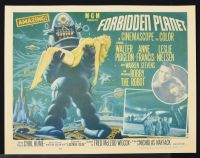
Half sheet theatrical release poster for
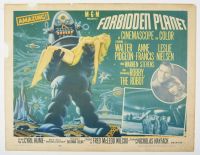
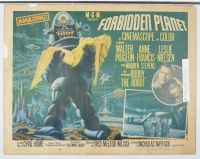
Forbidden Planet, a landmark 1956 science fiction film from Metro-Goldwyn-Mayer (MGM).
Directed by Fred M. Wilcox, it is widely considered one of the most influential sci-fi movies ever made, setting several cinematic "firsts":
Setting: The first sci-fi film set entirely on a foreign planet (Altair IV).
Technology: The first to depict humans traveling in a faster-than-light starship of their own creation.
Sound: The first Hollywood film with an entirely electronic musical score, composed by Bebe and Louis Barron.
Robotics: It introduced Robby the Robot, one of the first film robots with a distinct personality and sense of humor.
Plot & Inspiration
The film is a loose sci-fi adaptation of William Shakespeare’s The Tempest. In the 23rd century, Commander John J. Adams leads a crew to Altair IV to investigate the disappearance of a colony sent 20 years earlier. They find only two survivors: the reclusive Dr. Edward Morbius and his daughter, Altaira, living in a technological paradise built by the extinct, highly advanced Krell race. The crew soon faces an invisible "Monster from the Id"—a physical manifestation of Morbius's own subconscious fears unleashed by Krell technology.
Key Cast
Walter Pidgeon as Dr. Edward Morbius
Anne Francis as Altaira "Alta" Morbius
Leslie Nielsen as Commander John J. Adams (in one of his earliest dramatic roles)
Warren Stevens as Lt. "Doc" Ostrow
Marvin Miller as the voice of Robby the Robot
Cultural Impact
Forbidden Planet paved the way for high-budget, serious science fiction, directly inspiring Gene Roddenberry's Star Trek and later franchises like Star Wars. In 2013, the film was added to the U.S. National Film Registry for being "culturally, historically, or aesthetically significant".
Forbidden Planet, a landmark 1956 science fiction film from Metro-Goldwyn-Mayer (MGM).
Directed by Fred M. Wilcox, it is widely considered one of the most influential sci-fi movies ever made, setting several cinematic "firsts":
Setting: The first sci-fi film set entirely on a foreign planet (Altair IV).
Technology: The first to depict humans traveling in a faster-than-light starship of their own creation.
Sound: The first Hollywood film with an entirely electronic musical score, composed by Bebe and Louis Barron.
Robotics: It introduced Robby the Robot, one of the first film robots with a distinct personality and sense of humor.
Plot & Inspiration
The film is a loose sci-fi adaptation of William Shakespeare’s The Tempest. In the 23rd century, Commander John J. Adams leads a crew to Altair IV to investigate the disappearance of a colony sent 20 years earlier. They find only two survivors: the reclusive Dr. Edward Morbius and his daughter, Altaira, living in a technological paradise built by the extinct, highly advanced Krell race. The crew soon faces an invisible "Monster from the Id"—a physical manifestation of Morbius's own subconscious fears unleashed by Krell technology.
Key Cast
Walter Pidgeon as Dr. Edward Morbius
Anne Francis as Altaira "Alta" Morbius
Leslie Nielsen as Commander John J. Adams (in one of his earliest dramatic roles)
Warren Stevens as Lt. "Doc" Ostrow
Marvin Miller as the voice of Robby the Robot
Cultural Impact
Forbidden Planet paved the way for high-budget, serious science fiction, directly inspiring Gene Roddenberry's Star Trek and later franchises like Star Wars. In 2013, the film was added to the U.S. National Film Registry for being "culturally, historically, or aesthetically significant".
After 3
After
Disclaimer
The object and/or subject of this report is private property. This page is for informational purposes only. Unless clearly stated otherwise, all conservation and restoration has been performed by Poster Mountain (PM) or Los Angeles Paper Group (LAPG)I) PM-LAPG has not knowingly withheld any significant information from its evaluation report and to the best of its knowledge all statements and evaluations in this report are true and correct.
II) PM-LAPG stated in the Evaluation Report its own personal, unbiased and professional analysis, opinions and conclusions, which are subject to the assumptions and limited conditions in this evaluation report as set forth hereinabove.
III) PM-LAPG has no present or prospective interests in the property which is the subject matter of this report and it has no present or prospective personal interests or bias with respect to the participants in this matter.
IV) PM-LAPG and its employment and/or compensation for performing this evaluation or any future anticipated evaluation was not conditioned on any agreement or understanding, written or otherwise, that it would report (or present analysis in support) as predetermined specific authenticity, a predetermined evaluation that favors the cause of any party or the attainment of any specific result or occurrence of a specific subsequent event, such as value or marketability.
V) PM-LAPG prepared all opinions and conclusions about the subject property that were set forth in this Evaluation Report. If it has relied on significant evaluation assistance from any individual or individuals in the performance of this evaluation or the appropriation of this evaluation report, PM-LAPG has named such individuals and disclosed the specific task performed in this evaluation report. PM-LAPG certifies that any individual so named is qualified to the same extent as PM to perform the task. PM-LAPG has not authorized anyone to make a change to any item in this evaluation report, therefore, any change made to this evaluation is unauthorized and PM-LAPG will not take responsibility for it.
VI) The Client may not disclose or distribute this Evaluation Report to any potential purchasers of the subject property without first obtaining PM-LAPG's prior written consent. This consent must be obtained before this evaluation report may be disclosed or distributed to any other party, including, but not limited to, the public through advertising, public relations, news, sales, or other media.