
Travel is as Safe as Possible
One sheet vintage
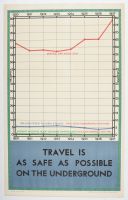
London Underground poster from around 1928. It is a masterful example of early 20th-century information design used for corporate reassurance and marketing.
During this era, under the leadership of administrator Frank Pick, the London Underground (then known as "The Underground") became a pioneer in using high-quality graphic art and data visualization to build public trust.
The "Exaggeration" Trick
The most fascinating part of this poster is its clever use of scale to make a statistical point. Look closely at the labels for the blue and green lines:
Red Line: Shows the total "Service Car Miles Run" (climbing toward 80 million).
Blue & Green Lines: These represent equipment failures and accidents. Crucially, the poster notes these are "ON A SCALE EXAGGERATED 1000 TIMES."
By magnifying the negative data by 1,000 and showing that it still barely registers at the bottom of the chart compared to the total miles traveled, the designer creates a powerful visual argument. It tells the commuter: "Even if our accidents were a thousand times worse than they actually are, they would still be a tiny fraction of our total service."
Historical Context
Safety Campaign: In the late 1920s, the Underground was expanding rapidly. Public anxiety about "modern" high-speed travel was common, so posters like this were designed to provide "scientific" proof of safety.
The Baynard Press: The small text at the bottom suggests it was printed by The Baynard Press, a famous London printing house that worked closely with the Underground to produce its iconic Art Deco and modernist posters.
Data Period: The chart covers the years 1920 to 1927, showing a post-WWI boom in service miles as the city recovered and grew.
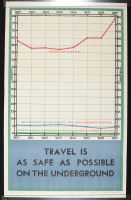
London Underground poster from around 1928. It is a masterful example of early 20th-century information design used for corporate reassurance and marketing.
During this era, under the leadership of administrator Frank Pick, the London Underground (then known as "The Underground") became a pioneer in using high-quality graphic art and data visualization to build public trust.
The "Exaggeration" Trick
The most fascinating part of this poster is its clever use of scale to make a statistical point. Look closely at the labels for the blue and green lines:
Red Line: Shows the total "Service Car Miles Run" (climbing toward 80 million).
Blue & Green Lines: These represent equipment failures and accidents. Crucially, the poster notes these are "ON A SCALE EXAGGERATED 1000 TIMES."
By magnifying the negative data by 1,000 and showing that it still barely registers at the bottom of the chart compared to the total miles traveled, the designer creates a powerful visual argument. It tells the commuter: "Even if our accidents were a thousand times worse than they actually are, they would still be a tiny fraction of our total service."
Historical Context
Safety Campaign: In the late 1920s, the Underground was expanding rapidly. Public anxiety about "modern" high-speed travel was common, so posters like this were designed to provide "scientific" proof of safety.
The Baynard Press: The small text at the bottom suggests it was printed by The Baynard Press, a famous London printing house that worked closely with the Underground to produce its iconic Art Deco and modernist posters.
Data Period: The chart covers the years 1920 to 1927, showing a post-WWI boom in service miles as the city recovered and grew.
Mounted
Disclaimer
The object and/or subject of this report is private property. This page is for informational purposes only. Unless clearly stated otherwise, all conservation and restoration has been performed by Poster Mountain (PM) or Los Angeles Paper Group (LAPG)I) PM-LAPG has not knowingly withheld any significant information from its evaluation report and to the best of its knowledge all statements and evaluations in this report are true and correct.
II) PM-LAPG stated in the Evaluation Report its own personal, unbiased and professional analysis, opinions and conclusions, which are subject to the assumptions and limited conditions in this evaluation report as set forth hereinabove.
III) PM-LAPG has no present or prospective interests in the property which is the subject matter of this report and it has no present or prospective personal interests or bias with respect to the participants in this matter.
IV) PM-LAPG and its employment and/or compensation for performing this evaluation or any future anticipated evaluation was not conditioned on any agreement or understanding, written or otherwise, that it would report (or present analysis in support) as predetermined specific authenticity, a predetermined evaluation that favors the cause of any party or the attainment of any specific result or occurrence of a specific subsequent event, such as value or marketability.
V) PM-LAPG prepared all opinions and conclusions about the subject property that were set forth in this Evaluation Report. If it has relied on significant evaluation assistance from any individual or individuals in the performance of this evaluation or the appropriation of this evaluation report, PM-LAPG has named such individuals and disclosed the specific task performed in this evaluation report. PM-LAPG certifies that any individual so named is qualified to the same extent as PM to perform the task. PM-LAPG has not authorized anyone to make a change to any item in this evaluation report, therefore, any change made to this evaluation is unauthorized and PM-LAPG will not take responsibility for it.
VI) The Client may not disclose or distribute this Evaluation Report to any potential purchasers of the subject property without first obtaining PM-LAPG's prior written consent. This consent must be obtained before this evaluation report may be disclosed or distributed to any other party, including, but not limited to, the public through advertising, public relations, news, sales, or other media.