
Stratocruiser
One sheet vintage promotional poster for the
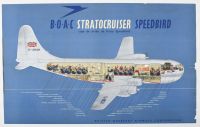
British Overseas Airways Corporation (BOAC), created circa 1950 by artist R. P. Hutchinson. It features a detailed "cutaway" illustration of the Boeing 377 Stratocruiser, which was the height of luxury travel in the early post-war era.
The Aircraft: G-AKGH "Caledonia"
The specific aircraft shown, registration G-AKGH, was named Caledonia. It served as the flagship of BOAC's Stratocruiser fleet and was the first of the type delivered to the airline on November 15, 1949. These planes were famously used on the "Monarch" service, an ultra-luxurious, first-class-only flight between London and New York.
Key Features and Layout
The Stratocruiser was unique for its "double-bubble" fuselage, which created two distinct levels:
Upper Deck: Contained the main passenger cabins, including the "Leito-Padrão" (standard sleepers) where seats could be converted into bunks for long overnight Atlantic crossings.
Lower Deck: Accessed via a spiral staircase (Escada), it featured a "Saleta e Bar" (Lounge and Bar), allowing passengers to socialize away from their seats—a level of space and luxury that earned it the nickname "The Flying Hotel."
Flight Crew: The diagram identifies a five-person flight deck crew: Captain (Comandante), Co-pilot, Engineer, Radio Operator, and Navigator.
Historical Context
Developed from the B-29 Superfortress bomber and the C-97 military transport, the Stratocruiser was one of the last and largest propeller-driven airliners. While passengers loved its comfort, the aircraft was notoriously difficult to maintain due to its complex 28-cylinder "corncob" engines. By 1959, BOAC retired its Stratocruiser fleet, replacing them with faster jet aircraft like the Boeing 707.
The text on this specific version of the poster is in Portuguese, likely produced for BOAC's routes and marketing in Brazil or Portugal during the 1950s.
British Overseas Airways Corporation (BOAC), created circa 1950 by artist R. P. Hutchinson. It features a detailed "cutaway" illustration of the Boeing 377 Stratocruiser, which was the height of luxury travel in the early post-war era.
The Aircraft: G-AKGH "Caledonia"
The specific aircraft shown, registration G-AKGH, was named Caledonia. It served as the flagship of BOAC's Stratocruiser fleet and was the first of the type delivered to the airline on November 15, 1949. These planes were famously used on the "Monarch" service, an ultra-luxurious, first-class-only flight between London and New York.
Key Features and Layout
The Stratocruiser was unique for its "double-bubble" fuselage, which created two distinct levels:
Upper Deck: Contained the main passenger cabins, including the "Leito-Padrão" (standard sleepers) where seats could be converted into bunks for long overnight Atlantic crossings.
Lower Deck: Accessed via a spiral staircase (Escada), it featured a "Saleta e Bar" (Lounge and Bar), allowing passengers to socialize away from their seats—a level of space and luxury that earned it the nickname "The Flying Hotel."
Flight Crew: The diagram identifies a five-person flight deck crew: Captain (Comandante), Co-pilot, Engineer, Radio Operator, and Navigator.
Historical Context
Developed from the B-29 Superfortress bomber and the C-97 military transport, the Stratocruiser was one of the last and largest propeller-driven airliners. While passengers loved its comfort, the aircraft was notoriously difficult to maintain due to its complex 28-cylinder "corncob" engines. By 1959, BOAC retired its Stratocruiser fleet, replacing them with faster jet aircraft like the Boeing 707.
The text on this specific version of the poster is in Portuguese, likely produced for BOAC's routes and marketing in Brazil or Portugal during the 1950s.
Mounted
Disclaimer
The object and/or subject of this report is private property. This page is for informational purposes only. Unless clearly stated otherwise, all conservation and restoration has been performed by Poster Mountain (PM) or Los Angeles Paper Group (LAPG)I) PM-LAPG has not knowingly withheld any significant information from its evaluation report and to the best of its knowledge all statements and evaluations in this report are true and correct.
II) PM-LAPG stated in the Evaluation Report its own personal, unbiased and professional analysis, opinions and conclusions, which are subject to the assumptions and limited conditions in this evaluation report as set forth hereinabove.
III) PM-LAPG has no present or prospective interests in the property which is the subject matter of this report and it has no present or prospective personal interests or bias with respect to the participants in this matter.
IV) PM-LAPG and its employment and/or compensation for performing this evaluation or any future anticipated evaluation was not conditioned on any agreement or understanding, written or otherwise, that it would report (or present analysis in support) as predetermined specific authenticity, a predetermined evaluation that favors the cause of any party or the attainment of any specific result or occurrence of a specific subsequent event, such as value or marketability.
V) PM-LAPG prepared all opinions and conclusions about the subject property that were set forth in this Evaluation Report. If it has relied on significant evaluation assistance from any individual or individuals in the performance of this evaluation or the appropriation of this evaluation report, PM-LAPG has named such individuals and disclosed the specific task performed in this evaluation report. PM-LAPG certifies that any individual so named is qualified to the same extent as PM to perform the task. PM-LAPG has not authorized anyone to make a change to any item in this evaluation report, therefore, any change made to this evaluation is unauthorized and PM-LAPG will not take responsibility for it.
VI) The Client may not disclose or distribute this Evaluation Report to any potential purchasers of the subject property without first obtaining PM-LAPG's prior written consent. This consent must be obtained before this evaluation report may be disclosed or distributed to any other party, including, but not limited to, the public through advertising, public relations, news, sales, or other media.