
Le Femme, David and Bathsheba
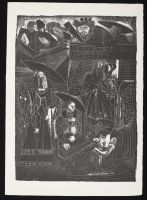
Fine Art by Pablo Picasso This artwork is an original lithograph by Pablo Picasso titled David and Bathsheba (after Lucas Cranach the Elder). Created between 1947 and 1949, this piece is part of a celebrated series that interprets the biblical story through a modern lens.
Artwork Overview
Picasso drew inspiration from a 1526 painting by the Northern Renaissance master Lucas Cranach the Elder, which he first saw in a black-and-white exhibition catalogue.
The Subject: The work depicts King David, shown at the top with a large head and harp, lustfully observing the young Bathsheba from his palace balcony while she gathers with her ladies around a pool.
Technique: Picasso created this by covering a zinc plate with black lithographic ink and then using a sharp scraper tool to "draw" the figures by scratching away the ink. This method results in the distinctive white-on-black linear style seen in your image.
Evolution (The "States"): Picasso revisited the same zinc plate multiple times over two years, creating a series of thirteen "states" or variations. As the series progressed, the images generally became more abstract, darker, and more complex.
Significance: This series is considered one of Picasso's major achievements in lithography, demonstrating his ability to transform historic art into his own unique cubist and expressionist style.
Collecting and Editions
Edition Size: Most published editions of these lithographs were limited to 50 impressions.
Museum Collections: Examples of this series are held by major institutions, including the Museum of Modern Art (MoMA) in New York, the British Museum, and the Picasso Museum in Barcelona.
Artwork Overview
Picasso drew inspiration from a 1526 painting by the Northern Renaissance master Lucas Cranach the Elder, which he first saw in a black-and-white exhibition catalogue.
The Subject: The work depicts King David, shown at the top with a large head and harp, lustfully observing the young Bathsheba from his palace balcony while she gathers with her ladies around a pool.
Technique: Picasso created this by covering a zinc plate with black lithographic ink and then using a sharp scraper tool to "draw" the figures by scratching away the ink. This method results in the distinctive white-on-black linear style seen in your image.
Evolution (The "States"): Picasso revisited the same zinc plate multiple times over two years, creating a series of thirteen "states" or variations. As the series progressed, the images generally became more abstract, darker, and more complex.
Significance: This series is considered one of Picasso's major achievements in lithography, demonstrating his ability to transform historic art into his own unique cubist and expressionist style.
Collecting and Editions
Edition Size: Most published editions of these lithographs were limited to 50 impressions.
Museum Collections: Examples of this series are held by major institutions, including the Museum of Modern Art (MoMA) in New York, the British Museum, and the Picasso Museum in Barcelona.
Disclaimer
The object and/or subject of this report is private property. This page is for informational purposes only. Unless clearly stated otherwise, all conservation and restoration has been performed by Poster Mountain (PM) or Los Angeles Paper Group (LAPG)I) PM-LAPG has not knowingly withheld any significant information from its evaluation report and to the best of its knowledge all statements and evaluations in this report are true and correct.
II) PM-LAPG stated in the Evaluation Report its own personal, unbiased and professional analysis, opinions and conclusions, which are subject to the assumptions and limited conditions in this evaluation report as set forth hereinabove.
III) PM-LAPG has no present or prospective interests in the property which is the subject matter of this report and it has no present or prospective personal interests or bias with respect to the participants in this matter.
IV) PM-LAPG and its employment and/or compensation for performing this evaluation or any future anticipated evaluation was not conditioned on any agreement or understanding, written or otherwise, that it would report (or present analysis in support) as predetermined specific authenticity, a predetermined evaluation that favors the cause of any party or the attainment of any specific result or occurrence of a specific subsequent event, such as value or marketability.
V) PM-LAPG prepared all opinions and conclusions about the subject property that were set forth in this Evaluation Report. If it has relied on significant evaluation assistance from any individual or individuals in the performance of this evaluation or the appropriation of this evaluation report, PM-LAPG has named such individuals and disclosed the specific task performed in this evaluation report. PM-LAPG certifies that any individual so named is qualified to the same extent as PM to perform the task. PM-LAPG has not authorized anyone to make a change to any item in this evaluation report, therefore, any change made to this evaluation is unauthorized and PM-LAPG will not take responsibility for it.
VI) The Client may not disclose or distribute this Evaluation Report to any potential purchasers of the subject property without first obtaining PM-LAPG's prior written consent. This consent must be obtained before this evaluation report may be disclosed or distributed to any other party, including, but not limited to, the public through advertising, public relations, news, sales, or other media.