
Mai Kai Restaurant
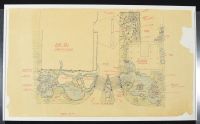
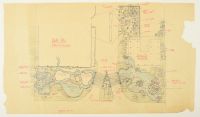
original landscape planting plan for the Mai-Kai Restaurant
in Fort Lauderdale, Florida. Specifically, this drawing details a tropical garden layout situated between the main restaurant building and a separate storage building on the property.
Plan Details
The hand-drawn blueprint includes several key historical and architectural features:
Central Garden: The plan shows a U-shaped tropical garden designed to be a lush, immersive environment for patrons.
Water Features: It maps out various lagoons and walking paths that weave through simulated rock formations and waterfalls, intended to create a sense of "escapism" from the outside world.
Planting Strategy: Original designer Pat Wells used over 400 different species of plants, some flown in from Hawaii, to ensure guests couldn't see the nearby highway traffic.
Storage Building: The rectangular structure on the right side of the plan is labeled as a "Storage Building," which was part of the original 1950s site configuration.
Historical Context
Designed by architect Charles F. McKirahan Sr. and opened in 1956, the Mai-Kai is listed on the National Register of Historic Places. Plans like this were essential for maintaining the restaurant's famous "South Seas" atmosphere. Recently, these original design intentions have been used to guide a $20 million renovation of the restaurant and its 2.7-acre grounds following a closure in 2020.
in Fort Lauderdale, Florida. Specifically, this drawing details a tropical garden layout situated between the main restaurant building and a separate storage building on the property.
Plan Details
The hand-drawn blueprint includes several key historical and architectural features:
Central Garden: The plan shows a U-shaped tropical garden designed to be a lush, immersive environment for patrons.
Water Features: It maps out various lagoons and walking paths that weave through simulated rock formations and waterfalls, intended to create a sense of "escapism" from the outside world.
Planting Strategy: Original designer Pat Wells used over 400 different species of plants, some flown in from Hawaii, to ensure guests couldn't see the nearby highway traffic.
Storage Building: The rectangular structure on the right side of the plan is labeled as a "Storage Building," which was part of the original 1950s site configuration.
Historical Context
Designed by architect Charles F. McKirahan Sr. and opened in 1956, the Mai-Kai is listed on the National Register of Historic Places. Plans like this were essential for maintaining the restaurant's famous "South Seas" atmosphere. Recently, these original design intentions have been used to guide a $20 million renovation of the restaurant and its 2.7-acre grounds following a closure in 2020.
After2
After
Disclaimer
The object and/or subject of this report is private property. This page is for informational purposes only. Unless clearly stated otherwise, all conservation and restoration has been performed by Poster Mountain (PM) or Los Angeles Paper Group (LAPG)I) PM-LAPG has not knowingly withheld any significant information from its evaluation report and to the best of its knowledge all statements and evaluations in this report are true and correct.
II) PM-LAPG stated in the Evaluation Report its own personal, unbiased and professional analysis, opinions and conclusions, which are subject to the assumptions and limited conditions in this evaluation report as set forth hereinabove.
III) PM-LAPG has no present or prospective interests in the property which is the subject matter of this report and it has no present or prospective personal interests or bias with respect to the participants in this matter.
IV) PM-LAPG and its employment and/or compensation for performing this evaluation or any future anticipated evaluation was not conditioned on any agreement or understanding, written or otherwise, that it would report (or present analysis in support) as predetermined specific authenticity, a predetermined evaluation that favors the cause of any party or the attainment of any specific result or occurrence of a specific subsequent event, such as value or marketability.
V) PM-LAPG prepared all opinions and conclusions about the subject property that were set forth in this Evaluation Report. If it has relied on significant evaluation assistance from any individual or individuals in the performance of this evaluation or the appropriation of this evaluation report, PM-LAPG has named such individuals and disclosed the specific task performed in this evaluation report. PM-LAPG certifies that any individual so named is qualified to the same extent as PM to perform the task. PM-LAPG has not authorized anyone to make a change to any item in this evaluation report, therefore, any change made to this evaluation is unauthorized and PM-LAPG will not take responsibility for it.
VI) The Client may not disclose or distribute this Evaluation Report to any potential purchasers of the subject property without first obtaining PM-LAPG's prior written consent. This consent must be obtained before this evaluation report may be disclosed or distributed to any other party, including, but not limited to, the public through advertising, public relations, news, sales, or other media.