
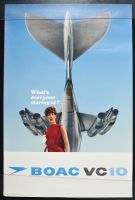
BOAC VC10
One sheet 1966 BOAC (British Overseas Airways Corporation) advertising poster for the Vickers VC10 jet airliner. The creative design, often featuring a stewardess in a red uniform and the tagline "What's everyone staring at?", aimed to highlight the aircraft's distinctive and then-revolutionary rear-engine configuration.
The Aircraft: Vickers VC10
The VC10 was a mid-sized, narrow-body long-range British jet airliner designed to meet BOAC's specific requirements for "hot and high" performance. It was intended for routes to Africa and the Middle East where runways were often shorter and high temperatures reduced aircraft lift.
Distinctive Design: It was one of only two airliners (alongside the Soviet Ilyushin Il-62) to feature a rear-engined quad layout, with four Rolls-Royce Conway engines mounted in pairs on the rear fuselage.
Performance: This configuration allowed for a "clean" wing with advanced high-lift devices, giving it excellent takeoff and climb performance.
Passenger Experience: Passengers favored the VC10 because the rear-mounted engines significantly reduced cabin noise and provided a smoother ride through turbulence.
Records: It held the subsonic record for a transatlantic crossing (5 hours and 1 minute) for 41 years until 2020.
History & Legacy
Service Life: Introduced by BOAC on April 29, 1964, it served until the early 1980s in commercial fleets.
Military Role: The Royal Air Force (RAF) utilized modified VC10s for strategic transport and later converted them into aerial refueling tankers. The type served the RAF until its final retirement in September 2013.
Commercial Fate: Only 54 VC10s were ever built. While technically advanced, its higher operating costs and the lengthening of runways worldwide (which favored competitors like the Boeing 707) limited its commercial success.
The Aircraft: Vickers VC10
The VC10 was a mid-sized, narrow-body long-range British jet airliner designed to meet BOAC's specific requirements for "hot and high" performance. It was intended for routes to Africa and the Middle East where runways were often shorter and high temperatures reduced aircraft lift.
Distinctive Design: It was one of only two airliners (alongside the Soviet Ilyushin Il-62) to feature a rear-engined quad layout, with four Rolls-Royce Conway engines mounted in pairs on the rear fuselage.
Performance: This configuration allowed for a "clean" wing with advanced high-lift devices, giving it excellent takeoff and climb performance.
Passenger Experience: Passengers favored the VC10 because the rear-mounted engines significantly reduced cabin noise and provided a smoother ride through turbulence.
Records: It held the subsonic record for a transatlantic crossing (5 hours and 1 minute) for 41 years until 2020.
History & Legacy
Service Life: Introduced by BOAC on April 29, 1964, it served until the early 1980s in commercial fleets.
Military Role: The Royal Air Force (RAF) utilized modified VC10s for strategic transport and later converted them into aerial refueling tankers. The type served the RAF until its final retirement in September 2013.
Commercial Fate: Only 54 VC10s were ever built. While technically advanced, its higher operating costs and the lengthening of runways worldwide (which favored competitors like the Boeing 707) limited its commercial success.
Disclaimer
The object and/or subject of this report is private property. This page is for informational purposes only. Unless clearly stated otherwise, all conservation and restoration has been performed by Poster Mountain (PM) or Los Angeles Paper Group (LAPG)I) PM-LAPG has not knowingly withheld any significant information from its evaluation report and to the best of its knowledge all statements and evaluations in this report are true and correct.
II) PM-LAPG stated in the Evaluation Report its own personal, unbiased and professional analysis, opinions and conclusions, which are subject to the assumptions and limited conditions in this evaluation report as set forth hereinabove.
III) PM-LAPG has no present or prospective interests in the property which is the subject matter of this report and it has no present or prospective personal interests or bias with respect to the participants in this matter.
IV) PM-LAPG and its employment and/or compensation for performing this evaluation or any future anticipated evaluation was not conditioned on any agreement or understanding, written or otherwise, that it would report (or present analysis in support) as predetermined specific authenticity, a predetermined evaluation that favors the cause of any party or the attainment of any specific result or occurrence of a specific subsequent event, such as value or marketability.
V) PM-LAPG prepared all opinions and conclusions about the subject property that were set forth in this Evaluation Report. If it has relied on significant evaluation assistance from any individual or individuals in the performance of this evaluation or the appropriation of this evaluation report, PM-LAPG has named such individuals and disclosed the specific task performed in this evaluation report. PM-LAPG certifies that any individual so named is qualified to the same extent as PM to perform the task. PM-LAPG has not authorized anyone to make a change to any item in this evaluation report, therefore, any change made to this evaluation is unauthorized and PM-LAPG will not take responsibility for it.
VI) The Client may not disclose or distribute this Evaluation Report to any potential purchasers of the subject property without first obtaining PM-LAPG's prior written consent. This consent must be obtained before this evaluation report may be disclosed or distributed to any other party, including, but not limited to, the public through advertising, public relations, news, sales, or other media.