
Tahiti Island
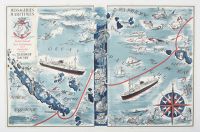
Misc vintage French travel poster and route map for the Messageries Maritimes shipping company, specifically highlighting its service between Tahiti, New Caledonia, and Australia.
AbeBooks
AbeBooks
+1
Created around 1950 by the artist Hervé Baille, the poster illustrates the "Pacific Ocean Line" routes serviced by the sister ships m.s. Caledonien and m.s. Tahitien.
Antique Print Map Room
Antique Print Map Room
+1
Historical Context & Features
The Vessels: Both ships were passenger-cargo liners launched in the early 1950s—the Caledonien in 1952 and the Tahitien in 1953. They were among the last major ships of their kind to operate long-haul voyages before being largely replaced by jet air travel in the 1960s.
The Route: These ships operated on one of the world's longest maritime lines, traveling from Marseille, France, through the Panama Canal, and across the Pacific to Sydney, Australia. A full round trip could take nearly four months.
Artistic Elements: The map features a whimsical "pictorial" style characteristic of Hervé Baille. It includes:
Vignettes of island life, palm trees, and local people.
Mythical sea creatures, including mermaids, a trident-wielding Neptune figure, and various marine life like an octopus and shark.
A decorative compass rose in the bottom right and the Messageries Maritimes logo (a unicorn on a crowned anchor) in the top left.
Wikipedia
Wikipedia
+5
Key Locations on the Map
Nouvelle Calédonie (New Caledonia): Shown prominently on the left with its capital, Nouméa.
Polynesian Islands: The right side highlights islands like Tahiti (with its capital Papeete), Bora Bora, and Moorea.
Shipping Lines: The red line traces the nautical route connecting these far-flung French territories with Australia.
AbeBooks
AbeBooks
+1
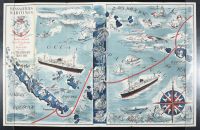
Created around 1950 by the artist Hervé Baille, the poster illustrates the "Pacific Ocean Line" routes serviced by the sister ships m.s. Caledonien and m.s. Tahitien.
Antique Print Map Room
Antique Print Map Room
+1
Historical Context & Features
The Vessels: Both ships were passenger-cargo liners launched in the early 1950s—the Caledonien in 1952 and the Tahitien in 1953. They were among the last major ships of their kind to operate long-haul voyages before being largely replaced by jet air travel in the 1960s.
The Route: These ships operated on one of the world's longest maritime lines, traveling from Marseille, France, through the Panama Canal, and across the Pacific to Sydney, Australia. A full round trip could take nearly four months.
Artistic Elements: The map features a whimsical "pictorial" style characteristic of Hervé Baille. It includes:
Vignettes of island life, palm trees, and local people.
Mythical sea creatures, including mermaids, a trident-wielding Neptune figure, and various marine life like an octopus and shark.
A decorative compass rose in the bottom right and the Messageries Maritimes logo (a unicorn on a crowned anchor) in the top left.
Wikipedia
Wikipedia
+5
Key Locations on the Map
Nouvelle Calédonie (New Caledonia): Shown prominently on the left with its capital, Nouméa.
Polynesian Islands: The right side highlights islands like Tahiti (with its capital Papeete), Bora Bora, and Moorea.
Shipping Lines: The red line traces the nautical route connecting these far-flung French territories with Australia.
Mounted
Disclaimer
The object and/or subject of this report is private property. This page is for informational purposes only. Unless clearly stated otherwise, all conservation and restoration has been performed by Poster Mountain (PM) or Los Angeles Paper Group (LAPG)I) PM-LAPG has not knowingly withheld any significant information from its evaluation report and to the best of its knowledge all statements and evaluations in this report are true and correct.
II) PM-LAPG stated in the Evaluation Report its own personal, unbiased and professional analysis, opinions and conclusions, which are subject to the assumptions and limited conditions in this evaluation report as set forth hereinabove.
III) PM-LAPG has no present or prospective interests in the property which is the subject matter of this report and it has no present or prospective personal interests or bias with respect to the participants in this matter.
IV) PM-LAPG and its employment and/or compensation for performing this evaluation or any future anticipated evaluation was not conditioned on any agreement or understanding, written or otherwise, that it would report (or present analysis in support) as predetermined specific authenticity, a predetermined evaluation that favors the cause of any party or the attainment of any specific result or occurrence of a specific subsequent event, such as value or marketability.
V) PM-LAPG prepared all opinions and conclusions about the subject property that were set forth in this Evaluation Report. If it has relied on significant evaluation assistance from any individual or individuals in the performance of this evaluation or the appropriation of this evaluation report, PM-LAPG has named such individuals and disclosed the specific task performed in this evaluation report. PM-LAPG certifies that any individual so named is qualified to the same extent as PM to perform the task. PM-LAPG has not authorized anyone to make a change to any item in this evaluation report, therefore, any change made to this evaluation is unauthorized and PM-LAPG will not take responsibility for it.
VI) The Client may not disclose or distribute this Evaluation Report to any potential purchasers of the subject property without first obtaining PM-LAPG's prior written consent. This consent must be obtained before this evaluation report may be disclosed or distributed to any other party, including, but not limited to, the public through advertising, public relations, news, sales, or other media.