
Grace Line South American Cruise
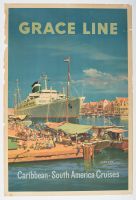
One sheet, This vintage travel poster, created around 1957, is an iconic advertisement for Grace Line's Caribbean-South America Cruises. It features artwork by the renowned maritime artist Carl G. Evers (1907–2000), who was celebrated for his meticulous and vibrant depictions of ships and sea life.
Artistic & Historical Details
Artist: Carl G. Evers was a prolific illustrator whose work frequently appeared in The Saturday Evening Post and Reader's Digest.
The Ship: The ocean liner depicted is likely the SS Santa Rosa or its sister ship, the SS Santa Paula. While these names were used for older vessels, the streamlined, single-funnel design in this poster represents the new luxury liners launched in 1958, which were specifically designed for Caribbean cruising.
The Location: The scene is set in the harbor of Willemstad, Curaçao, then part of the Netherlands West Indies. The background showcases the city's famous 17th-century Dutch colonial architecture with its distinctive bright colors and stepped gables.
The Scene: Willemstad’s Floating Market
The foreground captures the bustling energy of the "Floating Market" along the Sha Caprileskade.
Venezuelan Traders: Traditionally, merchants from nearby Venezuela would sail their small, canopy-covered boats to this pier to sell fresh tropical fruits, vegetables, and flowers directly to locals and tourists.
Cultural Snapshot: The poster highlights a man leading a donkey-drawn cart and locals interacting with passengers, emphasizing the exotic and lively atmosphere Grace Line marketed to American travelers during the mid-20th century.
Grace Line History
Grace Line (officially the W.R. Grace & Co. shipping subsidiary) was a dominant force in American shipping for over a century. Known for its "Santa" ships—all named with the prefix "Santa"—the line provided critical passenger and freight links between New York and the West Coast of South America, as well as luxury Caribbean loops. The company was eventually sold to Prudential Lines in 1969, marking the end of an era for the "Santa" fleet.
Artistic & Historical Details
Artist: Carl G. Evers was a prolific illustrator whose work frequently appeared in The Saturday Evening Post and Reader's Digest.
The Ship: The ocean liner depicted is likely the SS Santa Rosa or its sister ship, the SS Santa Paula. While these names were used for older vessels, the streamlined, single-funnel design in this poster represents the new luxury liners launched in 1958, which were specifically designed for Caribbean cruising.
The Location: The scene is set in the harbor of Willemstad, Curaçao, then part of the Netherlands West Indies. The background showcases the city's famous 17th-century Dutch colonial architecture with its distinctive bright colors and stepped gables.
The Scene: Willemstad’s Floating Market
The foreground captures the bustling energy of the "Floating Market" along the Sha Caprileskade.
Venezuelan Traders: Traditionally, merchants from nearby Venezuela would sail their small, canopy-covered boats to this pier to sell fresh tropical fruits, vegetables, and flowers directly to locals and tourists.
Cultural Snapshot: The poster highlights a man leading a donkey-drawn cart and locals interacting with passengers, emphasizing the exotic and lively atmosphere Grace Line marketed to American travelers during the mid-20th century.
Grace Line History
Grace Line (officially the W.R. Grace & Co. shipping subsidiary) was a dominant force in American shipping for over a century. Known for its "Santa" ships—all named with the prefix "Santa"—the line provided critical passenger and freight links between New York and the West Coast of South America, as well as luxury Caribbean loops. The company was eventually sold to Prudential Lines in 1969, marking the end of an era for the "Santa" fleet.
Mounted
Disclaimer
The object and/or subject of this report is private property. This page is for informational purposes only. Unless clearly stated otherwise, all conservation and restoration has been performed by Poster Mountain (PM) or Los Angeles Paper Group (LAPG)I) PM-LAPG has not knowingly withheld any significant information from its evaluation report and to the best of its knowledge all statements and evaluations in this report are true and correct.
II) PM-LAPG stated in the Evaluation Report its own personal, unbiased and professional analysis, opinions and conclusions, which are subject to the assumptions and limited conditions in this evaluation report as set forth hereinabove.
III) PM-LAPG has no present or prospective interests in the property which is the subject matter of this report and it has no present or prospective personal interests or bias with respect to the participants in this matter.
IV) PM-LAPG and its employment and/or compensation for performing this evaluation or any future anticipated evaluation was not conditioned on any agreement or understanding, written or otherwise, that it would report (or present analysis in support) as predetermined specific authenticity, a predetermined evaluation that favors the cause of any party or the attainment of any specific result or occurrence of a specific subsequent event, such as value or marketability.
V) PM-LAPG prepared all opinions and conclusions about the subject property that were set forth in this Evaluation Report. If it has relied on significant evaluation assistance from any individual or individuals in the performance of this evaluation or the appropriation of this evaluation report, PM-LAPG has named such individuals and disclosed the specific task performed in this evaluation report. PM-LAPG certifies that any individual so named is qualified to the same extent as PM to perform the task. PM-LAPG has not authorized anyone to make a change to any item in this evaluation report, therefore, any change made to this evaluation is unauthorized and PM-LAPG will not take responsibility for it.
VI) The Client may not disclose or distribute this Evaluation Report to any potential purchasers of the subject property without first obtaining PM-LAPG's prior written consent. This consent must be obtained before this evaluation report may be disclosed or distributed to any other party, including, but not limited to, the public through advertising, public relations, news, sales, or other media.