
Back to the Future II
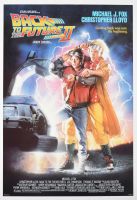
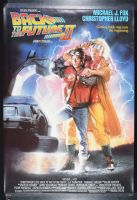
One sheet, iconic movie poster for Back to the Future Part II
, the 1989 science fiction sequel starring Michael J. Fox as Marty McFly and Christopher Lloyd as Dr. Emmett "Doc" Brown.
The film picks up immediately where the original left off, following the duo as they travel from 1985 to a futuristic 2015 to prevent Marty's future son from ruining the McFly family name. The story famously introduces the hoverboard and self-tying Nike shoes, which have since become legendary symbols of pop culture's vision of the future.
Key Facts About the Film
A Twisted Timeline: Much of the film deals with a dystopian "alternate 1985" created after their nemesis, Biff Tannen, steals the DeLorean and a sports almanac to make himself a wealthy and corrupt tycoon in the past.
Groundbreaking Tech: To allow Michael J. Fox to play multiple versions of himself in the same scene (like Marty and his children), filmmakers used the VistaGlide motion control system, which was pioneering at the time.
Back-to-Back Production: Parts II and III were actually filmed back-to-back, with only eight days of downtime between them.
Recasting: While most original actors returned, Elisabeth Shue replaced Claudia Wells as Jennifer Parker, and Jeffrey Weissman took over the role of George McFly from Crispin Glover.
The iconic artwork for the Back to the Future Part II movie poster was created by the legendary American illustrator Drew Struzan
.
Struzan is widely considered a master of his craft, known for his distinctive, hand-painted style that defined the visual identity of many major movie franchises during the 1980s and 90s. He illustrated the posters for all three films in the Back to the Future trilogy, keeping a consistent layout for each while adding specific details to hint at the different time periods explored in each sequel.
Key Details About the Artwork:
The Design: While Struzan
was the illustrator, the overall poster was designed by Tom Martin
.
Signature Style: To create the final image, Struzan
used a combination of acrylic paint applied with an airbrush for the foundation and colored pencils for fine detailing on gessoed illustration board.
The Pose: For the sequels, Struzan
worked from a special photoshoot with actors Michael J. Fox and Christopher Lloyd. Interestingly, for the original movie poster, Fox was unavailable, so Struzan
actually used himself as the body model for Marty McFly, later adding Fox's head from reference photos.
Legacy: Beyond Back to the Future, Struzan
created over 150 movie posters, including seminal work for Star Wars, Indiana Jones, The Thing, Blade Runner, and Harry Potter.
Struzan
passed away on October 13, 2025, at the age of 78, leaving behind a legacy as one of the last great masters of illustrated movie posters.
, the 1989 science fiction sequel starring Michael J. Fox as Marty McFly and Christopher Lloyd as Dr. Emmett "Doc" Brown.
The film picks up immediately where the original left off, following the duo as they travel from 1985 to a futuristic 2015 to prevent Marty's future son from ruining the McFly family name. The story famously introduces the hoverboard and self-tying Nike shoes, which have since become legendary symbols of pop culture's vision of the future.
Key Facts About the Film
A Twisted Timeline: Much of the film deals with a dystopian "alternate 1985" created after their nemesis, Biff Tannen, steals the DeLorean and a sports almanac to make himself a wealthy and corrupt tycoon in the past.
Groundbreaking Tech: To allow Michael J. Fox to play multiple versions of himself in the same scene (like Marty and his children), filmmakers used the VistaGlide motion control system, which was pioneering at the time.
Back-to-Back Production: Parts II and III were actually filmed back-to-back, with only eight days of downtime between them.
Recasting: While most original actors returned, Elisabeth Shue replaced Claudia Wells as Jennifer Parker, and Jeffrey Weissman took over the role of George McFly from Crispin Glover.
The iconic artwork for the Back to the Future Part II movie poster was created by the legendary American illustrator Drew Struzan
.
Struzan is widely considered a master of his craft, known for his distinctive, hand-painted style that defined the visual identity of many major movie franchises during the 1980s and 90s. He illustrated the posters for all three films in the Back to the Future trilogy, keeping a consistent layout for each while adding specific details to hint at the different time periods explored in each sequel.
Key Details About the Artwork:
The Design: While Struzan
was the illustrator, the overall poster was designed by Tom Martin
.
Signature Style: To create the final image, Struzan
used a combination of acrylic paint applied with an airbrush for the foundation and colored pencils for fine detailing on gessoed illustration board.
The Pose: For the sequels, Struzan
worked from a special photoshoot with actors Michael J. Fox and Christopher Lloyd. Interestingly, for the original movie poster, Fox was unavailable, so Struzan
actually used himself as the body model for Marty McFly, later adding Fox's head from reference photos.
Legacy: Beyond Back to the Future, Struzan
created over 150 movie posters, including seminal work for Star Wars, Indiana Jones, The Thing, Blade Runner, and Harry Potter.
Struzan
passed away on October 13, 2025, at the age of 78, leaving behind a legacy as one of the last great masters of illustrated movie posters.
Mounted
Disclaimer
The object and/or subject of this report is private property. This page is for informational purposes only. Unless clearly stated otherwise, all conservation and restoration has been performed by Poster Mountain (PM) or Los Angeles Paper Group (LAPG)I) PM-LAPG has not knowingly withheld any significant information from its evaluation report and to the best of its knowledge all statements and evaluations in this report are true and correct.
II) PM-LAPG stated in the Evaluation Report its own personal, unbiased and professional analysis, opinions and conclusions, which are subject to the assumptions and limited conditions in this evaluation report as set forth hereinabove.
III) PM-LAPG has no present or prospective interests in the property which is the subject matter of this report and it has no present or prospective personal interests or bias with respect to the participants in this matter.
IV) PM-LAPG and its employment and/or compensation for performing this evaluation or any future anticipated evaluation was not conditioned on any agreement or understanding, written or otherwise, that it would report (or present analysis in support) as predetermined specific authenticity, a predetermined evaluation that favors the cause of any party or the attainment of any specific result or occurrence of a specific subsequent event, such as value or marketability.
V) PM-LAPG prepared all opinions and conclusions about the subject property that were set forth in this Evaluation Report. If it has relied on significant evaluation assistance from any individual or individuals in the performance of this evaluation or the appropriation of this evaluation report, PM-LAPG has named such individuals and disclosed the specific task performed in this evaluation report. PM-LAPG certifies that any individual so named is qualified to the same extent as PM to perform the task. PM-LAPG has not authorized anyone to make a change to any item in this evaluation report, therefore, any change made to this evaluation is unauthorized and PM-LAPG will not take responsibility for it.
VI) The Client may not disclose or distribute this Evaluation Report to any potential purchasers of the subject property without first obtaining PM-LAPG's prior written consent. This consent must be obtained before this evaluation report may be disclosed or distributed to any other party, including, but not limited to, the public through advertising, public relations, news, sales, or other media.