
Chinese Market
Halfsheet
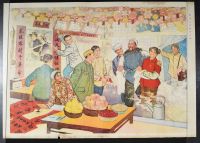
Chinese propaganda poster from 1977 titled New Year's Eve in the collective household Jitíhù de chúx? zh? yè). It was designed by Xia Zhenping.
Poster Details
Title: The Chinese title translates to "New Year's Eve in the collective household". The vertical text on the left reads (Zh?g?n nóngc?n gàn gémìng), which means "Settle down in the countryside to make revolution". The text over the doorway calls to "break with old traditional concepts and celebrate a revolutionary Spring Festival".
Context: The poster was published in June 1977, shortly after the end of the Cultural Revolution. It reflects the "Up to the Mountains and Down to the Countryside Movement," which sent urban youth (known as "sent-down youth" or zh?q?ng) to rural areas to live with and learn from the peasants.
Imagery: The scene depicts a lively and joyful New Year's Eve celebration in a communal setting (a collective household).
People of various ages and ethnicities are gathered, smiling and preparing food, highlighting unity and harmony.
A young woman in a red jacket is a "barefoot doctor," an icon of the era, carrying her medical bag and returning from making house calls in the snow.
Traditional New Year elements like lanterns and couplets (the red papers with calligraphy) are present, but the overall message is one of revolutionary modernization and collective life replacing traditional, family-centered celebrations.
Art Style: The poster uses bright colors and is inspired by the traditional Chinese New Year prints (niánhuà), a genre often adapted for propaganda purposes during this period.
Chinese propaganda poster from 1977 titled New Year's Eve in the collective household Jitíhù de chúx? zh? yè). It was designed by Xia Zhenping.
Poster Details
Title: The Chinese title translates to "New Year's Eve in the collective household". The vertical text on the left reads (Zh?g?n nóngc?n gàn gémìng), which means "Settle down in the countryside to make revolution". The text over the doorway calls to "break with old traditional concepts and celebrate a revolutionary Spring Festival".
Context: The poster was published in June 1977, shortly after the end of the Cultural Revolution. It reflects the "Up to the Mountains and Down to the Countryside Movement," which sent urban youth (known as "sent-down youth" or zh?q?ng) to rural areas to live with and learn from the peasants.
Imagery: The scene depicts a lively and joyful New Year's Eve celebration in a communal setting (a collective household).
People of various ages and ethnicities are gathered, smiling and preparing food, highlighting unity and harmony.
A young woman in a red jacket is a "barefoot doctor," an icon of the era, carrying her medical bag and returning from making house calls in the snow.
Traditional New Year elements like lanterns and couplets (the red papers with calligraphy) are present, but the overall message is one of revolutionary modernization and collective life replacing traditional, family-centered celebrations.
Art Style: The poster uses bright colors and is inspired by the traditional Chinese New Year prints (niánhuà), a genre often adapted for propaganda purposes during this period.
Disclaimer
The object and/or subject of this report is private property. This page is for informational purposes only. Unless clearly stated otherwise, all conservation and restoration has been performed by Poster Mountain (PM) or Los Angeles Paper Group (LAPG)I) PM-LAPG has not knowingly withheld any significant information from its evaluation report and to the best of its knowledge all statements and evaluations in this report are true and correct.
II) PM-LAPG stated in the Evaluation Report its own personal, unbiased and professional analysis, opinions and conclusions, which are subject to the assumptions and limited conditions in this evaluation report as set forth hereinabove.
III) PM-LAPG has no present or prospective interests in the property which is the subject matter of this report and it has no present or prospective personal interests or bias with respect to the participants in this matter.
IV) PM-LAPG and its employment and/or compensation for performing this evaluation or any future anticipated evaluation was not conditioned on any agreement or understanding, written or otherwise, that it would report (or present analysis in support) as predetermined specific authenticity, a predetermined evaluation that favors the cause of any party or the attainment of any specific result or occurrence of a specific subsequent event, such as value or marketability.
V) PM-LAPG prepared all opinions and conclusions about the subject property that were set forth in this Evaluation Report. If it has relied on significant evaluation assistance from any individual or individuals in the performance of this evaluation or the appropriation of this evaluation report, PM-LAPG has named such individuals and disclosed the specific task performed in this evaluation report. PM-LAPG certifies that any individual so named is qualified to the same extent as PM to perform the task. PM-LAPG has not authorized anyone to make a change to any item in this evaluation report, therefore, any change made to this evaluation is unauthorized and PM-LAPG will not take responsibility for it.
VI) The Client may not disclose or distribute this Evaluation Report to any potential purchasers of the subject property without first obtaining PM-LAPG's prior written consent. This consent must be obtained before this evaluation report may be disclosed or distributed to any other party, including, but not limited to, the public through advertising, public relations, news, sales, or other media.