
Chinese Artillery
Halfsheet vintage
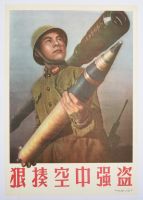
Chinese propaganda poster from 1958, titled "Forcefully Beat Back the Air Bandits". It features a soldier from the People's Liberation Army (PLA) holding a large anti-aircraft shell, conveying a strong message of military strength and defense of the nation's airspace.
Poster Analysis
Imagery: The poster uses the visual of a determined Chinese soldier in uniform, prominently displaying a large anti-aircraft shell and part of an anti-aircraft gun. This emphasizes the preparedness and power of the military.
Text: The large Chinese characters at the bottom, (H?n zòu k?ngzh?ng qiángdào), translate to "Forcefully Beat Back the Air Bandits" or "China Artillery Beat Back The Air Bandits". The language is aggressive and patriotic.
Context: These types of posters were common during periods of political tension and military build-up in China, such as around the time of the Second Taiwan Strait Crisis (also known as the 1958 Taiwan Strait Crisis). The "air bandits" likely referred to enemy aircraft, which could include those from Taiwan or the United States, as anti-U.S. sentiment was frequent in propaganda of the era.
Style: The artistic style is social realism, typical of communist propaganda art from the Soviet Union and China in the mid-20th century, using bold colors (especially "China red") and strong lines to evoke revolutionary romanticism and national pride.
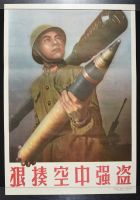
Chinese propaganda poster from 1958, titled "Forcefully Beat Back the Air Bandits". It features a soldier from the People's Liberation Army (PLA) holding a large anti-aircraft shell, conveying a strong message of military strength and defense of the nation's airspace.
Poster Analysis
Imagery: The poster uses the visual of a determined Chinese soldier in uniform, prominently displaying a large anti-aircraft shell and part of an anti-aircraft gun. This emphasizes the preparedness and power of the military.
Text: The large Chinese characters at the bottom, (H?n zòu k?ngzh?ng qiángdào), translate to "Forcefully Beat Back the Air Bandits" or "China Artillery Beat Back The Air Bandits". The language is aggressive and patriotic.
Context: These types of posters were common during periods of political tension and military build-up in China, such as around the time of the Second Taiwan Strait Crisis (also known as the 1958 Taiwan Strait Crisis). The "air bandits" likely referred to enemy aircraft, which could include those from Taiwan or the United States, as anti-U.S. sentiment was frequent in propaganda of the era.
Style: The artistic style is social realism, typical of communist propaganda art from the Soviet Union and China in the mid-20th century, using bold colors (especially "China red") and strong lines to evoke revolutionary romanticism and national pride.
Mounted
Disclaimer
The object and/or subject of this report is private property. This page is for informational purposes only. Unless clearly stated otherwise, all conservation and restoration has been performed by Poster Mountain (PM) or Los Angeles Paper Group (LAPG)I) PM-LAPG has not knowingly withheld any significant information from its evaluation report and to the best of its knowledge all statements and evaluations in this report are true and correct.
II) PM-LAPG stated in the Evaluation Report its own personal, unbiased and professional analysis, opinions and conclusions, which are subject to the assumptions and limited conditions in this evaluation report as set forth hereinabove.
III) PM-LAPG has no present or prospective interests in the property which is the subject matter of this report and it has no present or prospective personal interests or bias with respect to the participants in this matter.
IV) PM-LAPG and its employment and/or compensation for performing this evaluation or any future anticipated evaluation was not conditioned on any agreement or understanding, written or otherwise, that it would report (or present analysis in support) as predetermined specific authenticity, a predetermined evaluation that favors the cause of any party or the attainment of any specific result or occurrence of a specific subsequent event, such as value or marketability.
V) PM-LAPG prepared all opinions and conclusions about the subject property that were set forth in this Evaluation Report. If it has relied on significant evaluation assistance from any individual or individuals in the performance of this evaluation or the appropriation of this evaluation report, PM-LAPG has named such individuals and disclosed the specific task performed in this evaluation report. PM-LAPG certifies that any individual so named is qualified to the same extent as PM to perform the task. PM-LAPG has not authorized anyone to make a change to any item in this evaluation report, therefore, any change made to this evaluation is unauthorized and PM-LAPG will not take responsibility for it.
VI) The Client may not disclose or distribute this Evaluation Report to any potential purchasers of the subject property without first obtaining PM-LAPG's prior written consent. This consent must be obtained before this evaluation report may be disclosed or distributed to any other party, including, but not limited to, the public through advertising, public relations, news, sales, or other media.